
Advertisement
Judge Questions Jail’s Treatment of Suspect in Press Gala Shooting
A federal magistrate ordered that the D.C. Department of Corrections explain why it had placed Cole Tomas Allen in especially restrictive conditions.

A federal magistrate judge raised concerns on Monday that the man accused of trying to kill President Trump and top cabinet members at an annual press gala had been placed in unusually punitive detention for days while awaiting next steps in court.
During a hastily scheduled hearing in Washington, Magistrate Judge Zia M. Faruqui demanded answers about how the man had been placed on suicide watch, denied a number of basic services and held in what the judge called “effectively solitary confinement” for nearly a week, all while the government has been slow to establish key facts in the federal case against him.
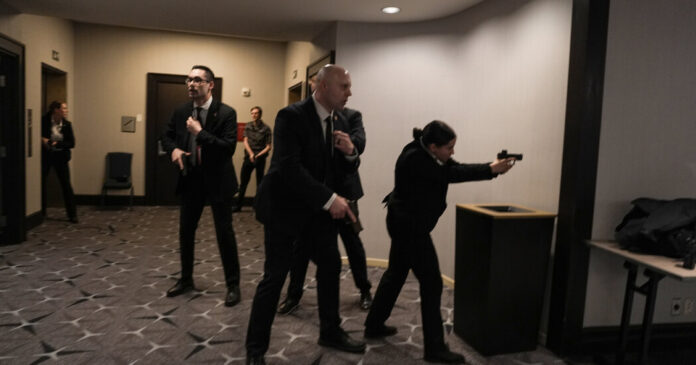
The man, Cole Tomas Allen, 31, had appeared in court last week, where prosecutors said they were charging him with trying to assassinate Mr. Trump and discharging a weapon while he stormed the White House Correspondents’ Association dinner, an annual gala for journalists. The Justice Department also accused Mr. Allen of transporting guns, including a pump-action shotgun, from California to Washington, and plotting to kill a number of top officials in a predetermined order.
Mr. Allen had been expected to appear in court later in May, but Judge Faruqui set a rapid hearing on Monday after Mr. Allen’s lawyers raised alarms over the weekend about the terms of his imprisonment. Among other things, his lawyers said Mr. Allen had been placed on suicide watch without a complete psychiatric evaluation and was regularly being held alone for as many as 23 hours per day.
Tony Towns, an official from the D.C. Department of Corrections, told the court that the psychiatric evaluation process had been routine, adding that “every case is different” and that no final determination had been made on how Mr. Allen would be held moving forward.
At the hearing, Judge Faruqui grilled Mr. Towns about how Mr. Allen had been placed under watch, stripping him of some basic privileges including visits, nonlegal phone calls and access to a Bible. Eugene Ohm, a federal public defender representing Mr. Allen, said he had been held alone for up to 23 hours a day — conditions that Judge Faruqui described as “effectively solitary confinement.”
“I’m obviously very concerned about how we’ve gotten here,” Judge Faruqui said.
The judge contrasted Mr. Allen’s treatment with that of dozens of people convicted of violent crimes during the Jan. 6 Capitol riot who were placed in lower security housing and cleared out of precautions for suicide. By comparison, Judge Faruqui said, Mr. Allen has been placed in “the most punitive, harshest” conditions despite having no criminal history.
“He’s been treated completely differently than anyone I’ve ever seen,” the judge added.
Judge Faruqui ordered the Department of Corrections to report back by 9 a.m. Tuesday, sharing any determination or updates on Mr. Allen’s housing status.
Throughout the hearing, Mr. Allen appeared subdued, looking on from his lawyers’ table dressed in a bright orange jumpsuit. At the end of the hearing, he acknowledged Judge Faruqui’s request that he continue to reach out through his lawyers if conditions did not improve.
“You cannot simply accept that this is how it’s going to be,” the judge said, drawing a nod from Mr. Allen.
Since Mr. Allen’s initial appearance last week, the government has grown more resolute in calling for serious penalties. Last week, investigators submitted new information about the hours leading up to the dinner, releasing a timeline they said showed Mr. Allen scoping out the wing of the Washington Hilton where the gala was held and gearing up to try to stage an attack.
Even as prosecutors had initially announced serious charges against Mr. Allen, which could carry a sentence of life in prison, the government had stopped short of making one key finding: that it was Mr. Allen who shot and injured a Secret Service agent who was hospitalized after the dinner.
But over the weekend, Jeanine Pirro, the U.S. attorney in Washington, said investigators had concluded Mr. Allen was responsible.
“It is definitively his bullet,” she said on CNN’s “State of the Union” program on Sunday.
“This was a premeditated, violent act calculated to take down the president and anyone who was in the line of fire,” Ms. Pirro told the CNN journalist Jake Tapper. “And you and I were both in that combat zone.”
Zach Montague is a Times reporter covering the federal courts, including the legal disputes over the Trump administration’s agenda.
Related Content
Advertisement