
What began on Dec. 28 in Tehran as a revolt against economic hardship and the collapse of the national currency quickly spread across dozens of other Iranian cities and provinces. People from diverse socioeconomic, religious and ethnic backgrounds joined what has become the largest anti-regime protest since the 1979 revolution.
Chants of “death to the dictator” and “death to Khamenei” echoed far beyond Tehran’s Grand Bazaar. As a response, the government shut off all internet services, leaving roughly 92 million Iranians in a digital blackout since Jan. 8.
The protests are not an isolated eruption but the latest chapter in a continuous cycle of uprisings from the 1999 student movement, the Green movement of 2009, the protests of 2017 and the bloody November of 2019, the “uprising of the thirsty” in 2021 and the Woman, Life, Freedom uprising of 2022. Each was driven by different grievances but united by a deepening crisis of legitimacy and governance.
For authoritarian regimes, internet blackouts are a powerful political tool of repression that conceal state violence.
Violence justified for ‘security’
As the protests spread, the regime responded by unleashing lethal violence on the streets. Security forces fired live ammunition and pellet guns at demonstrators, deployed tear gas, carried out mass arrests and raided medical facilities where injured protesters were being treated, including hospitals in Illam and Tehran.
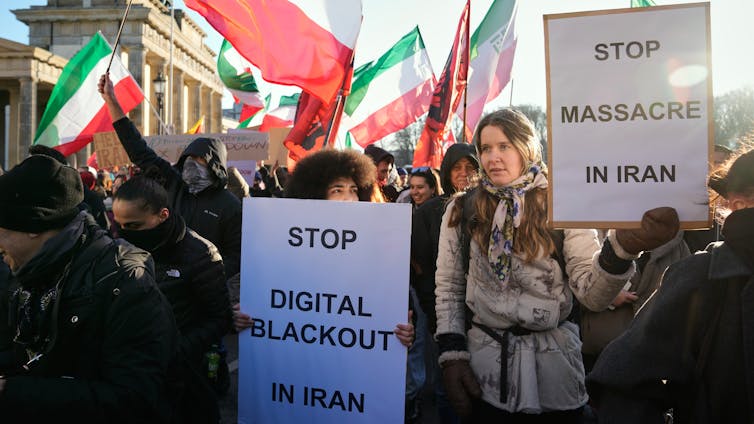
Arrests have surpassed 40,000, while estimates of the death toll vary widely, with reports suggesting that tens of thousands have been killed during the most intense days of repression. In cities such as Rasht, witnesses documented massacres as protesters attempted to flee security forces.
At the same time, state media outlets and senior political and judicial officials labelled protesters “terrorist agents” serving the United States and Israel, rhetoric that helped legitimize extreme violence in the name of national security.
The internet blackout as political strategy
Plunging millions of people into digital darkness was not a security precaution but a deliberate strategy used to disrupt collective action, prevent the documentation of state violence and control what both domestic and international audiences could see.
Mobile data, broadband connections and even phone lines were cut across the country, leaving families unable to contact loved ones, protesters cut off from one another and the outside world largely blind to events inside Iran. This was neither an unprecedented move nor a temporary security response. Iranian authorities have repeatedly restricted or disabled internet and telephone access during periods of sociopolitical unrest.
Under blackout conditions, the internet is not simply a space for expression, it is vital infrastructure that allows for information to flow.
By fragmenting connectivity, the state does not need to erase every image or silence every voice. It only needs to prevent a shared public record from forming. Violence becomes harder to document, deaths harder to count and accountability easier to evade.
Diaspora activism under blackout conditions
Outside Iran, this enforced silence prompted a wave of digital mobilization.
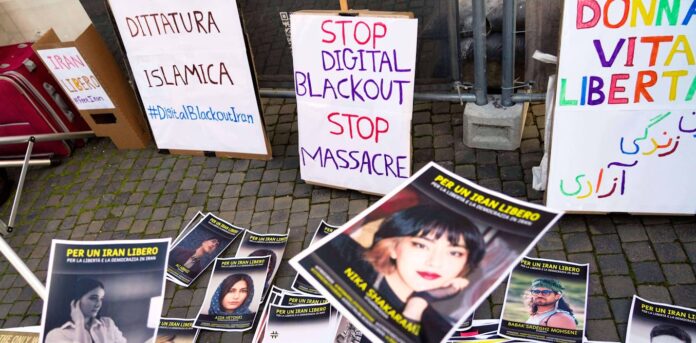
Iranians in the diaspora and their allies turned to platforms such as X and Instagram, circulating the hashtag #DigitalBlackoutIran to draw global attention to the shutdown and the escalating repression inside Iran. The hashtag became a way to make absence visible, revealing that the lack of images, videos and updates was itself the product of deliberate regime suppression and crackdown.
As the blackout continues, what’s at stake is not simply connectivity but the ability to bear witness. The struggle over internet access in Iran is therefore a deeply political one: it’s a struggle over who’s allowed to narrate, who’s allowed to be seen and whose suffering is allowed to register as real.
This use of #DigitalBlackoutIran didn’t emerge in vaccuum. It drew on previous movements and uprisings in Iran, where independent journalists are tightly restricted and repressed, public dissent is criminalized and uprisings are often followed by violent crackdowns and information blackouts.
When people cannot safely gather, publish or speak openly, and when documentation is actively disrupted, hashtags become a way of speaking out and of preserving what might otherwise disappear.
They allow dispersed users to find one another and construct a shared narrative of what’s happening. In this sense, hashtags function as a tool for mobilization and advocacy and as living archives of protest, keeping a record of repression and resistance alive when the state seeks to fragment, deny or erase it.
Yet the very visibility that gives hashtag activism its power also makes it vulnerable under authoritarian rule.
Read more: What Iran’s latest protests tell us about power, memory and resistance
In Iran, the regime does not rely solely on blocking platforms or cutting access. It also actively manipulates online conversations from within. Alongside internet shutdowns, blocking social media platforms and filtering news websites, the state deploys co-ordinated networks of pro-regime accounts, often referred to as a “cyber army,” to disrupt protest hashtags.
These accounts flood hashtags with abusive and degrading language, disinformation and conspiracy narratives. The aim is to make participation emotionally, psychologically and socially costly.
This strategy reflects a broader shift in how autocratic regimes manage dissent online. Rather than silencing opposition, they increasingly seek to dominate digital spaces by overwhelming them, blurring truth with falsehood, intimidation with debate and visibility with noise.
The communications blackout and the disruption of online space point to the same reality in Iran: both operate as deliberate strategies of repression embedded in the regime’s broader architecture of control and discipline.
Under these conditions, the role of Iranians in the diaspora, along with sustained international media coverage, becomes critical not only in countering the silencing of dissent within Iran, but also in resisting the systematic erasure, distortion and fragmentation of the country’s ongoing history of defiance.