

Advertisement
The smoke isn’t going away, but where it affects air quality will shift over the next few days. Conditions were improving Saturday for parts of the Northeast, a forecaster said.

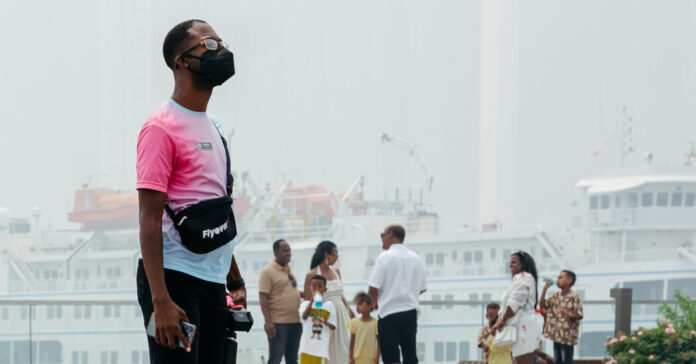
All week long, wildfire smoke swirling to the east from Minnesota and Ontario has darkened skies, ruined outdoor plans and sent air quality plummeting for millions of people across the United States and Canada.
The plume of smoke far above the Earth’s surface has not gone away on Saturday, but where and when it sends pollution to the ground this weekend will shift considerably by the hour.
Forecast is based on models and may underestimate smoke because of cloud cover or other obstructions. Contours show estimates of wildfire smoke near the surface. Source: National Oceanic and Atmospheric Administration Madison Dong, Bea Malsky and Joey K. Lee/The New York Times
Amid the hard-to-pin-down forecast, air quality warnings and alerts remained in place across many of the affected states and provinces.
Some places that saw a reprieve on Friday, including parts of Minnesota, Wisconsin and Michigan, are likely to endure the smoke again on Saturday as shifting winds pull the densest smoke back to them. Forecasters warned that the air quality would once again worsen and limit visibility on lakes and roads across the Upper Midwest.
In New York City and other parts of the Northeast, conditions improved Saturday morning and the skies were expected to continue to clear in the afternoon and evening. A weather system moving through on Saturday will bring the chance of severe thunderstorms, and the rain is likely to flush out the smoke.
“We will soon be out of the thickest part of the smoke in the Northeast, which we’ve been in for a few days,” said Brian Hurley, a meteorologist with the Weather Prediction Center.
Those storms could deliver enough rain to cause flash flooding throughout the day on Saturday. The worst are expected in the afternoon and evening, the National Weather Service said, warning that high winds could bring down trees and power lines and that even a tornado would be possible.
While the thunderstorms could help knock some of the smoke out of the air, the smoke itself complicates the forecast: It can block sunlight, keeping temperatures cooler at the surface and preventing storms from rising and intensifying.
Whatever smoke isn’t brought down by rain could disperse into a lighter haze or clear out completely Saturday night.
A plume of smoke that was drifting south from Canada into the upper Midwest on Saturday was expected to move east on Sunday. Acrid air will return to the Northeast, though Mr. Hurley said that it could remain higher in the atmosphere and be less impactful to people on the ground.
“The smoke on Sunday could be on the order of three to four times less dense than what we were seeing in recent days,” Mr. Hurley said.
Here’s what else to know about the wildfires and their smoke:
-
The smoke is coming from fires burning out of control across parts of central Canada and the boundary waters of northern Minnesota, with little sign that they would wane anytime soon. The authorities reported five new wildfires emerging overnight in the Canadian province of Ontario, where 185 were burning as of Saturday morning. Read more about the wildfires in Canada here, and the Minnesota fires here.
-
President Trump threatened on Friday to charge Canada tariffs to pay for harms caused by the wildfire smoke affecting American cities, joining a handful of Republican lawmakers who have criticized the Canadian government for what they claimed was poor forest management. Prime Minister Mark Carney did not immediately address the accusations on Friday, but he suggested this week that the United States should do more to combat climate change. Doug Ford, the premier of Ontario, has criticized the complaints from American lawmakers. Read more ›
-
Scientists estimate that wildfire smoke is linked to tens of thousands of deaths a year, and that human-caused climate change is responsible for a growing share of them. Read more ›
Judson Jones is a meteorologist and reporter for The Times who forecasts and covers extreme weather.
Amy Graff is a Times reporter covering weather, wildfires and earthquakes.
Related Content
Advertisement