

The Liberal government’s recent budget aims to reduce the size of the federal public service by around 40,000 positions, which is roughly 10 per cent of the workforce. The government argues that the size of the public service has swelled to an unsustainable level.
Needless to say, federal public sector workers cannot relish this prospect.
Along with the Conservatives, two NDP members voted to pass the budget in order to avoid another election. But in their public responses to the budget, New Democrats have emphasized concern over the cuts by expressing their hesitation about supporting it.
This decision could have significant electoral consequences in that it may drive public sector workers away from the Liberal Party of Canada to the NDP in the next election.
Deep divide?
A conventional understanding of Canadian politics suggests a stark divide between public sector workers who support expanding the welfare state and private-sector employees who oppose that.
A Conservative-leaning pundit has portrayed contemporary Canadian politics as a battle between a “public class, who live on the avails of taxation, and a private class, who pay the taxes.” The “public class” in this instance is largely made up of public sector workers who “would welcome an expansion of the state, which would benefit their class.”
In a recent paper published in the Canadian Review of Sociology, we studied the political divide between Canadian public and private-sector workers.
We identified a sectoral divide whereby public sector workers are distinctly less likely to vote for the Conservatives than other parties. The graphs below show how being in the public sector has on impact on whether someone votes for the Conservatives, Liberals or NDP versus the two other parties combined since the 1960s.
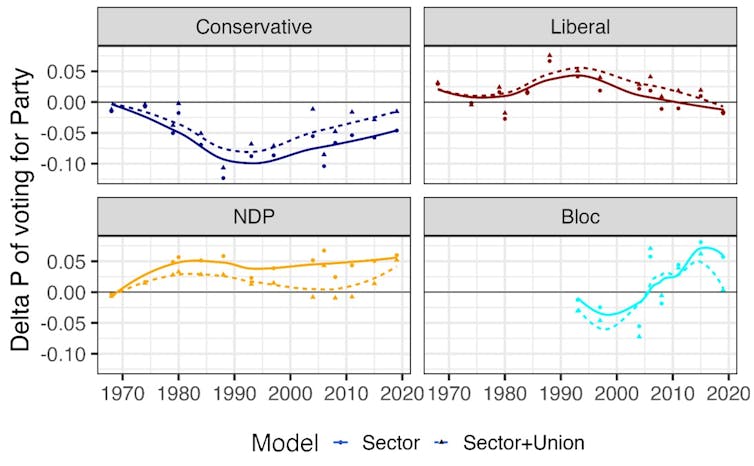
Sectoral status seems to have the largest impact on NDP support, rather than the Liberals. But one feature of our analysis shows that increased support for the NDP and the Liberals is primarily — although not exclusively — attributable to the fact that the public sector is heavily unionized.
Effectively, non-unionized public sector workers demonstrate a weaker proclivity to support the Liberals and the NDP.
This is curious and complicates some of the stark commentary on the divide between public and private sector workers. If public sector workers were so interested in choosing a party out of self-interest, they would presumably support the federal Liberals because of their greater electability, rather than the NDP, who rarely exercise influence at the federal level.
Left-leaning attitudes
Overall, our data says something about motivation: public sector voters in Canada are more inclined to support the NDP and the Liberals — not necessarily out of self-interest to expand their budgets or increase their salaries, but because they have political attitudes more to the left than their private sector counterparts.
We show this from the information illustrated below, which shows the average support for four different types of socio-economic policies: publicly delivered child care; a government role in creating jobs, increased wealth redistribution from rich to poor and increased spending on welfare.
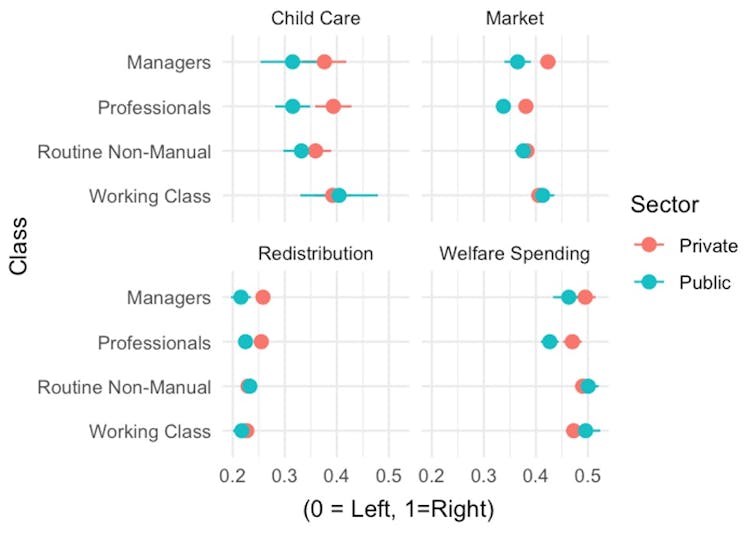
These data points were amassed from the Canada Election Studies from 1993 to 2019, and report support for these policies by class and sector of employment.
What’s striking about this chart is that on all four measures, public sector managers and professionals are more left-wing than their public sector counterparts.
But there is virtually no difference in the policy preferences at the level of working or routine non-manual classes. By contrast, if we run the same analysis with measures on social or cultural issues, we find almost no difference between public and private sector employees.
So the public and private sector divide in Canada today exists in some small measure because higher-class public sector workers are more left-wing economically than their higher-class private sector counterparts.

Hope on the horizon for the NDP?
We also examined whether public sector employees vote at higher rates. If public sector workers were interested in voting for the left in order to maximize their budgets, presumably, they would vote at greater rates overall.
But we found that public and private sector employees vote at roughly the same rate.
Overall, we find that there is in fact a sectoral divide in Canada. Public sector workers in Canada tend to vote Liberal or NDP. However, they do so primarily because of their more left-wing attitudes toward economic policy and redistribution, not necessarily only because of narrower interests related to job security.
The Liberal government’s intention to reduce the size of the federal public service could very likely drive some of their voters back to the NDP in the next federal election.
Want to write?
Write an article and join a growing community of more than 216,500 academics and researchers from 5,389 institutions.