
Advertisement
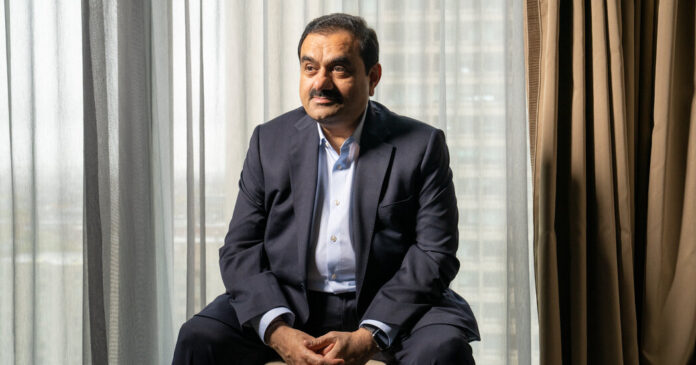
The decision came after a meeting in which a lawyer for the billionaire, Gautam Adani, made an unusual offer, according to people familiar with the matter.

When the Justice Department indicted India’s richest man in the final weeks of the Biden administration, prosecutors described an “elaborate” bribery scheme involving “corruption and fraud at the expense of U.S. investors.”
Now, according to several people with knowledge of the case, the Justice Department is planning to drop the charges altogether.
The reversal came after the Indian billionaire, Gautam Adani, hired a new legal team led by Robert J. Giuffra Jr., one of President Trump’s personal lawyers and the co-chairman of the prominent firm Sullivan & Cromwell.
Mr. Giuffra’s efforts on Mr. Adani’s behalf culminated in a previously unreported meeting last month at the Justice Department’s headquarters in Washington, according to people familiar with the meeting. Mr. Giuffra ticked through about 100 slides outlining why prosecutors lacked basic evidence, as well as the jurisdiction even to bring the case, one of the people said.
Another slide also made an unusual offer: If prosecutors dropped the charges, Mr. Adani would be willing to invest $10 billion in the American economy and create 15,000 jobs, echoing a pledge he had made in the wake of Mr. Trump’s election.
As part of the same meeting, Mr. Giuffra sought to resolve a parallel civil case against Mr. Adani brought by the Securities and Exchange Commission, as well as a separate investigation by the Treasury Department. Both of those agencies are now preparing to strike settlements with Mr. Adani and impose financial penalties, according to people familiar with the deals.
Although prosecutors later told Mr. Giuffra that the $10 billion investment would play no role in the resolution of the criminal case, his offer received a favorable response from at least one senior Justice Department official at the meeting, according to the people familiar with the meeting.
The proposal — which Mr. Trump could have touted as a political and economic win — underscores the highly transactional approach to justice in Mr. Trump’s second term.
Over the past year, he has awarded pardons to his donors and even a business partner, while prosecutors in his Justice Department have dropped charges and investigations against other political allies. Those results, a striking break from prosecutorial norms, have fueled the perception that freedom is up for sale in Mr. Trump’s Washington, emboldening defendants to offer economic settlement terms that were once unthinkable.
The people with knowledge of Mr. Adani’s case said that prosecutors were not pulling back as a political favor to Mr. Adani, who has a close relationship with Prime Minister Narendra Modi of India. Instead, one of them said, a dismissal would reflect the Trump administration’s broader retreat from foreign bribery cases and its reluctance to act as a global corporate police force.
Even if the criminal charges against Mr. Adani are dismissed, he is still expected to incur financial penalties, the people with knowledge of the case said.
The S.E.C. settlement, which could be announced as soon as Thursday, is expected to result in a penalty of about $18 million, the people said. Mr. Adani would pay a portion of the settlement, while a co-defendant would pay the balance.
And the Treasury Department, which was separately investigating Mr. Adani’s companies for shipping Iranian gas in violation of U.S. sanctions, is preparing to extract a penalty of its own, potentially about $275 million, the people added.
Although the deal could still fall apart, the Justice Department could move to dismiss the charges in the coming days, according to people familiar with the deal.
The indictment, which federal prosecutors in Brooklyn secured in late 2024, carried geopolitical implications. Mr. Adani is an infrastructure titan in India, and his company, the Adani Group, has been a driving force behind building the country’s biggest ports and highways, while also operating airports and owning a television news channel.
He has a net worth of $104 billion, making him the 17th-wealthiest person in the world, according to Bloomberg’s Billionaire Index.
Prosecutors charged Mr. Adani with securities fraud conspiracy and wire fraud conspiracy, accusing him, his nephew and six other associates of orchestrating a $265 million scheme to bribe Indian government officials to secure lucrative solar contracts in India. The defendants, prosecutors said, also lied about the bribery scheme when they were trying to raise money from American investors.
The defendants have not entered pleas and are not in custody because none of them were living in the United States when the indictment was announced.
In November 2024, a week before the charges were unsealed, Mr. Adani posted on X that his conglomerate would invest $10 billion in American energy and infrastructure projects and create up to 15,000 jobs as part of deepening U.S.-India relations. By that time, Bloomberg News had already reported that U.S. prosecutors were investigating Mr. Adani.
He also wrote on X that Mr. Trump, who had just been re-elected, was an “embodiment of unbreakable tenacity, unshakable grit, relentless determination and the courage to stay true to his beliefs.”
The unsealing of the charges complicated his investment plans. And as the charges threatened his access to American markets and his ability to travel freely outside India, Mr. Adani’s lawyers began pushing law enforcement officials to dismiss the cases against him. Last summer, Mr. Adani brought on a team of lawyers from Sullivan & Cromwell, including Mr. Giuffra.
By then, Mr. Giuffra was also representing Mr. Trump in the appeal of his criminal conviction in Manhattan for falsifying records to cover up hush money paid to a porn star.
After Mr. Giuffra took over Mr. Adani’s case, he moved to get the S.E.C. case dismissed. In a court filing, he argued that the case barely had any connection to the United States, saying that the allegations centered on a solar energy project in India with no American bidders and no American consumers.
Mr. Adani’s lawyers also submitted affidavits from experts — including a former S.E.C. commissioner — who argued that the conduct occurred in India, and the investors did not in fact lose money.
When Mr. Giuffra raised the $10 billion investment offer in the meeting last month, it was a small portion of his overall presentation, but it caught the attention of senior Justice Department officials.
One of the officials, Trent McCotter, appeared to draw a parallel to the case against former Mayor Eric Adams of New York, in which the Justice Department abandoned corruption charges against Mr. Adams in exchange for his cooperation with immigration enforcement, according to people familiar with the meeting.
Mr. McCotter, who was named principal associate deputy attorney general in April, said he thought the considerations behind the dismissal of the Adams case were appropriate, some of the people said.
Before he joined the Justice Department in January, Mr. McCotter had publicly indicated his support for dropping the charges against Mr. Adams. Last year, he submitted a court filing arguing in favor of the decision.
The Adams case resulted in a public confrontation between the Justice Department in Washington and the U.S. attorney’s office in Manhattan, leading prosecutors on the case to resign in protest of a deal that they saw as a quid pro quo between the Trump administration and the mayor of New York.
And in the Adani case, some government officials have pushed back for months on efforts by Mr. Adani’s lawyers to get the case dismissed, according to people familiar with the matter.
Five associates of Mr. Adani were charged under the Foreign Corrupt Practices Act, which prohibits companies that operate in the United States from paying bribes overseas to win business.
Last year, the Justice Department dismissed a case against former executives of Cognizant Technology Solutions Corp. that accused them of authorizing a bribery scheme in India — shortly after Mr. Trump issued an executive order pausing enforcement of the Foreign Corrupt Practices Act.
The executive order criticized the law for criminalizing “routine business practices in other nations,” arguing that it hurt American economic competitiveness and national security.
Michael S. Schmidt, Kenneth P. Vogel and Alex Travelli contributed reporting.
Nicole Hong is an investigative reporter for The Times based in New York.
Ben Protess is an investigative reporter at The Times, covering President Trump.
William K. Rashbaum is a Times reporter covering municipal and political corruption, the courts and broader law enforcement topics in New York.
Devlin Barrett covers the Justice Department and the F.B.I. for The Times.
Related Content
Advertisement