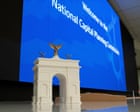

Donald Trump’s plans to build a skyline-altering arch in the nation’s capital won initial approval Thursday from a key federal commission, but its members put off a decision on whether a federal law that limits building heights should be applied to this project.
Despite overwhelming public opposition, the National Capital Planning Commission voted to approve preliminary site and building plans for the 250ft (76m) arch the Republican president wants to build on a traffic circle at the Virginia end of the Memorial Bridge from Washington.
The project, one of several being pursued by Trump in his quest to reshape parts of the nation’s capital to his liking, moved a step closer to reality with the vote.
Staff had recommended in its report on the project that the commission grant such approval and request a series of changes so the arch would comply with the Height of Buildings Act. The suggested changes included redistributing the heights among the main structure of the arch, the habitable roof, where an observation deck is planned, and the statues that would top it.
But commissioners, led by chair Will Scharf, voted to continue deliberations on whether the law indeed applies.
The staff report said the commission has long applied the law in its approval process. Scharf said the applicant, which is the interior department, had, as requested, provided a legal analysis that he said makes a “compelling argument” that the law “is not binding on the federal government”.
The interior department oversees the federal land where the arch would be built.
Eight of the 12 commissioners, including Scharf and two others appointed by Trump, voted for preliminary approval. One was against, and the remaining three commissioners voted present.
“This is a complex project,” Scharf said before the vote. He said a vote on final approval could come at the agency’s next meeting, in September.
All 12 commissioners listened to a summary of the staff report and its recommendations, and heard from several dozen people who had signed up to testify about the project.
As the commissioners met, construction continued at the White House on a $400m ballroom Trump is building there and crews draped tarps over the stone columns at the north entrance to the mansion, where work is being done to scrape off layers of paint.
Some of those who testified against Trump’s project opposed building a celebratory arch so close to Arlington national cemetery. Others suggested it would be more appropriate for a neighborhood near the Capitol and sporting venues.
Opponents say the arch is too big and would disrupt the carefully designed view between the Lincoln Memorial and Arlington national cemetery that was meant to symbolize the reunification of the north and the south after the civil war.
The arch would be more than twice as tall as the Lincoln Memorial, which is 99ft (30m) tall, and close to half the height of the Washington Monument, at about 555ft (169m) tall.
Concerns about vehicular traffic and pedestrian safety also were expressed on Thursday. Others insisted that Congress must approve the arch – a position Trump disagrees with.
The US Commission of Fine Arts, a separate federal agency, approved the design for the arch in May. The National Capital Planning Commission oversees construction on federal land in the city and began reviewing the arch plan in June.
Trump had said last year that the arch could be paid for with unused funds from the hundreds of millions of dollars he said he has raised from corporations, donors and other wealthy people to pay to build a new $400m ballroom at the White House.
But, as it turns out, some public money will be used for the ballroom project, as well as the arch. The White House has not released a cost estimate for the arch.