
Advertisement
The White House has warned staff not to wager on government decisions, but his family’s involvement with these firms undermines the president’s message.

By Ben Protess
Ben Protess covers the Trump family businesses. He reported from New York.
When a U.S. soldier was indicted on Thursday on charges of using classified information to place prediction market bets, it seemed to confirm President Trump’s lament just hours before that “the whole world unfortunately has become somewhat of a casino.”
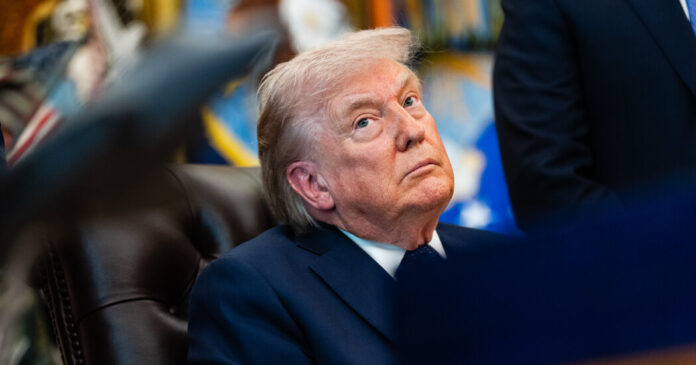
“I was never much in favor of it,” Mr. Trump said from the Oval Office, when asked about concerns that federal employees might be leveraging insider information on the prediction markets. “I don’t like it conceptually. It is what it is. I’m not happy with any of that stuff.”
Yet Mr. Trump and his family stand to profit from the very same industry.
The president’s publicly traded media company unveiled its own prediction market product last year. And the president’s eldest son, Donald Trump Jr., has ties to two of the industry’s top firms, including Polymarket, the platform that prosecutors say was used by the soldier for well-timed bets.
The result, ethics experts say, is a jarring juxtaposition between Mr. Trump’s public comments and his family’s private business.
While the president’s criticism of the prediction markets raised the prospect of new regulation, the reality is that little is likely to change. Last year, Mr. Trump’s administration backed away from enforcement efforts against Polymarket, and it is unclear whether regulators will adopt any new oversight measures.
“Presidential statements used to be the gold standard, but this is not true for President Trump,” Jeffrey A. Engel, founding director of the Center for Presidential History at Southern Methodist University, said.
“What he does is more important than what he says,” Mr. Engel said, adding, “I don’t think his comments will bother the prediction markets in the least.
Prediction markets, a fast-growing industry, allow consumers to place wagers on the likelihood of a future event, from cricket match scores to the release date of an album by the Canadian rap star Drake. But bettors can also weigh in on military and national security matters around the world. Some of those outcomes could be known or affected by a small group of decision makers, including those in Mr. Trump’s inner circle.
Mr. Trump made his remarks on Thursday, just hours before federal prosecutors in Manhattan charged Master Sgt. Gannon Ken Van Dyke, an Army Special Forces soldier who had helped capture Nicolás Maduro of Venezuela. Sgt. Van Dyke, prosecutors said, made more than $400,000 by betting on different outcomes related to Venezuela after learning of the operation.
He is not the only government employee suspected of placing well-timed bets on Venezuela and the war in Iran. There was a surge of suspicious trading related to the war last month. In response, Congress is considering legislation to limit government officials’ use of prediction markets, while officials in some states are also considering new regulations.
Senator Elissa Slotkin of Michigan, the lead Democratic sponsor of legislation that would bar any public official from placing prediction-market bets using nonpublic information they learn in the course of their jobs, has warned about “operational risk” and threats to national security.
It remains unclear whether the Republican-led Congress will advance the bipartisan bill. Asked about the president’s son’s ties to Polymarket and Kalshi, Ms. Slotkin said in an interview last month that she feared the White House could throw up barriers to passing the bill by pressuring Republicans not to support it.
“It’s too politically dicey,” she said, adding: “There is not a single important issue of the day where I don’t feel the shadow of Trump and his sons.”
In a statement, Davis Ingle, a spokesman for the White House, said: “President Trump has been crystal clear: While he seeks a strong and profitable stock market for everyone, members of Congress and other government officials should be prohibited from using nonpublic information for financial benefit. The only special interest that will ever guide President Trump is the best interest of the American people.”
There is no blanket prohibition on government employees’ placing bets on prediction markets, though prosecutors can still file fraud charges, as they did against Sgt. Van Dyke. He was also charged with unlawful use of confidential government information.
The White House issued a warning to staff last month against insider trading, amid a surge of suspicious trading on prediction markets, oil futures and stocks hinging on crucial moments in the conflict.
And the president’s remarks on Thursday served as another warning.
But his own family’s business interests could undermine the effectiveness of that message.
Last year, the publicly traded company that operates his social media platform, Truth Social, unveiled a new product called Truth Predict. The company, Trump Media & Technology Group, said the product would allow Truth Social users to trade prediction contracts “related to major events and milestones, such as political elections, interest and inflation rate changes.”
Truth Predict is not yet operational, according to a company spokeswoman, who said that the product was being developed and tested before launch.
A spokesman for Donald Trump Jr., who is a Trump Media board member, said he was not involved in the decision to create Truth Predict. The spokesman, Andrew Surabian, said that it was not a board-level resolution and that Donald Trump Jr. was not a part of the company’s day-to-day operations.
The younger Mr. Trump, however, has ties to both of the biggest prediction markets, Polymarket and its rival, Kalshi.
He is a paid adviser to Kalshi. And 1789 Capital, a venture capital firm in which Donald Trump Jr. is a partner, has invested in Polymarket. Mr. Trump is also an unpaid adviser to the company.
Mr. Surabian said that Donald Trump Jr.’s only involvement with prediction markets was to advise Kalshi and Polymarket on marketing strategies and to back Polymarket financially. He said that the president’s son did not trade on their platforms and that he never interacted with the federal government on behalf of any company he had invested in or advised.
There is no indication that Donald Trump Jr. will now seek to influence his father’s position on prediction markets. And it is unclear how firm the president’s position is.
Even his complaint that the world was becoming “somewhat of a casino” was an odd remark, coming from him. Mr. Trump spent years owning casinos, though they all eventually closed or changed hands.
Megan Mineiro contributed reporting.
Ben Protess is an investigative reporter at The Times, covering President Trump.
Related Content
Advertisement