
In his account of Tony Blair’s years in power, The New Machiavelli, Jonathan Powell sets out two opposing strategies for any British prime minister in dealing with their counterpart in the White House.
The first, he says, is “cutting a bella figura” – parading for show – by openly criticising the US president, for which he gives the example of the French. The other, and the approach preferred by Powell, is to do diplomacy in private and build a close relationship, in the hope of having greater influence.
These days, Powell is Keir Starmer’s national security adviser and his closest, most influential lieutenant on world affairs. That his prescription for the UK’s strategy towards Donald Trump is so close to the prime minister’s natural instincts goes some way to explaining that.
At his Downing Street press conference on Monday, Starmer said that he was determined to find a “pragmatic, sensible and sustained” route through the latest crisis – and would prefer “calm discussion” with the US president rather than “gesture politics” that could damage the relationship.
Yet within 24 hours of his measured address, Trump had set off another diplomatic bomb – this time by launching an extraordinary broadside against the UK’s Chagos deal, which he had previously warmly endorsed.
At the same time, Trump posted an AI-generated image on his Truth Social platform of him in the Oval Office with European leaders including Starmer, presenting them with a map showing Greenland, Canada and Venezuela covered in the US flag.
Starmer says “being pragmatic does not mean being passive” and that mature alliances are “not about pretending differences don’t exist; they are about addressing them directly, respectfully”.
But his entire Trump strategy– already called into question by some political opponents – is under more intense scrutiny than ever, with polls suggesting public disapproval over his handling of the US president is mounting.
Ed Davey, the leader of the Liberal Democrats, the third biggest party in the House of Commons, has described Trump as “a bully” and suggested he behaves as “an international gangster”. “The only way to deal with a bully is to stand up to them,” he added. Privately, some inside the ruling Labour party agree.
However, Starmer’s cabinet ministers swung in behind his “keep calm and carry on” strategy.
Darren Jones, his chief secretary, said the prime minister had been “very clear” that he disagreed with Trump over Greenland but had shown that “private, proper” diplomacy worked on issues such as tariffs and Ukraine.
“It’s noisy, I understand that, it’s challenging, it’s not normal for geopolitical discussion to be handled in this way. But British diplomacy is working,” Jones told the BBC.
Douglas Alexander, the Scotland secretary, told Channel 4 News: “I would rather have Keir Starmer in charge right now than Richard Curtis. We all watched Love Actually at Christmas. It’s a great film, but it’s not a very effective guide to how to do international diplomacy.
“Of course there will be politicians who are able to have either angry posts on social media or demand the PM do this or that, but I for one feel a sense of relief that in serious times we have a serious leader in Downing Street.”
Even some cabinet ministers who are privately critical of Starmer’s approach at home defended his strategy, suggesting that while it was the harder course at home, it was also the right one for the UK’s national interest.
One cabinet minister said: “I have no doubt that Keir’s private reaction was that he was as horrified as the rest of us. But I’m not sure what we’d gain from saying publicly what we all are feeling so viscerally at the moment … we have to see how this all unfolds.”
Another source said: “I don’t think we’d gain very much from attacks just to get some headlines for a day or two, only to cause irreparable damage to a partnership that’s so important to us, and to our national security”.
However, others said they wanted to see how the chaos unleashed by Trump unfurled, saying that any attempts to take Greenland by force would be a gamechanger.
“We’re in completely uncharted territory,” said another cabinet minister. “I totally understand why people are looking at Macron and Carney and saying ‘Starmer, why can’t we be a bit more like that?’
“Keir may reach a point where he has to recalibrate, or we have to urge him to do so. But for now we have to get behind him.”
Another government source added: “People want the prime minister to have a good relationship with the US. But I definitely think that if Trump gets even more unpredictable we will have to reassess”.
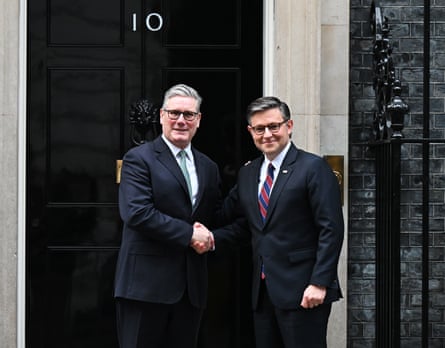
But even if Trump is volatile, it appears senior figures in his administration are trying to limit the damage. In what looked like an attempt to smooth over US-UK relations, the US House speaker, Mike Johnson, on Tuesday told the UK parliament he had spoken “at length” to the president and that his mission in London was to “help calm the waters”.
In Davos, where European leaders lined up to condemn Trump’s “new colonialism”, his commerce secretary, Howard Lutnick, told Rachel Reeves, the UK finance minister: “We love you. We do.”
“Thank you very much,” Reeves responded. “The feeling is mutual.” Love, actually? For now, perhaps, at the top of the UK government. But Starmer may yet find his heart is broken.