

Dustin Volz and Robert Jimison
Dustin Volz has covered congressional debates about the Foreign Intelligence Surveillance Act for over a decade. Robert Jimison covers Congress with a focus on foreign affairs and national security.
Hopes dim for renewing a warrantless surveillance law as Trump digs in on Bill Pulte.
Image
Hopes were fading on Wednesday for a breakthrough in Congress to salvage a warrantless surveillance law before its expiration this weekend, after President Trump dug in on naming a close ally who has alienated members of both parties to a top intelligence post.
Unless lawmakers act by midnight on Friday, the law, known as Section 702 of the Foreign Intelligence Surveillance Act, or FISA, will sunset. It is the legal underpinning for what is widely considered to be the most powerful surveillance tool the federal government has at its disposal, credited with generating intelligence that thwarts terror plots, defangs foreign hackers, curtails drug trafficking and gleans key insights for policymakers about chief rivals like China and Russia.
Trump administration officials and some Republican lawmakers have warned that letting Section 702 lapse would risk grave security threats to the United States, especially as the war in Iran grinds on.
But while a bipartisan coalition had been pushing toward a deal to extend it, Mr. Trump injected fresh chaos into the debate last week by naming Bill Pulte, his top housing official and a confidant without any national security experience, as acting director of national intelligence.
Even some Republicans expressed reservations, noting his lack of qualifications for the post. And days later, a bipartisan coalition blocked a renewal from moving forward in the Senate, as even Democrats who had previously been working with Republicans to forge an agreement to renew the law said they would not vote to do so unless Mr. Trump withdrew Mr. Pulte as his pick.
Congressional leaders had already been struggling to find enough votes amid longstanding privacy objections to pass compromise legislation that would renew Section 702 for three years.
Senator John Thune, Republican of South Dakota and the majority leader, conceded on Wednesday that there was now almost no chance of acting on such a bill before the law expired, and he was instead gauging support for a short-term extension of a few weeks.
But Congress has already punted on the issue twice this year, and efforts to do so a third time failed in the Senate on Wednesday. They also appeared unlikely to succeed in the House, where leaders scheduled a vote Thursday on a short-term extension that lawmakers and congressional aides said they were not confident would have the votes to pass.
Republican congressional leaders have toiled in recent days to persuade the president to drop Mr. Pulte — or at least to name a permanent replacement for the top intelligence post who could be quickly confirmed — arguing that they could not muster the votes to renew Section 702 otherwise. Speaker Mike Johnson met with Mr. Trump at the White House both Tuesday and Wednesday, and Mr. Pulte attended the Tuesday session, according to people familiar with the matter who insisted on anonymity to detail confidential discussions.
But while Mr. Johnson described Tuesday’s meeting as “very productive,” he did not indicate any progress had been made.
“The Democrats now have taken a hostage on this, and they’re suggesting they might not advance it,” Mr. Johnson said afterward. “We cannot allow FISA to go dark. It would be a dangerous prospect, and I think everybody who’s reasonable understands that.”
Mr. Thune said on Tuesday that he was encouraging the White House to nominate a permanent director of national intelligence to quell Democratic opposition.
“Getting some certainty and closure on that issue about who that might be will certainly play an important role in unlocking the support we need to get FISA done,” Mr. Thune said.
But instead of following Republicans’ advice, Mr. Trump appears to have responded to the pushback by growing more resolute in his insistence on installing Mr. Pulte. On Tuesday evening, after his meeting with Mr. Johnson and Mr. Pulte, the president posted on social media that Mr. Pulte would assume the duties of his new job from Tulsi Gabbard, the current spy chief, on June 19 instead of the end of the month, which was to be her last day.
Then on Wednesday, he posted on social media that he was “looking for a permanent ODNI Nominee with experience in National Security,” but did not offer a name. He said Mr. Pulte would “execute the immediate and needed downsizing of the office, reverting staff to their home agencies,” and pushed Congress to send him a short-term extension of Section 702 to allow time to select a permanent nominee.
He later told reporters Mr. Pulte would have the job “for a short while.” Federal law generally allows an acting official to serve for up to 210 days.
The law has for years generated controversy and criticism from both conservatives and liberals over how intelligence agencies, including the National Security Agency and the Federal Bureau of Investigation, use the spying powers it authorizes. That is because Section 702, while aimed at scooping up private messages of foreigners abroad, also allows the collection — without a warrant — of an unknown volume of material from Americans, including when they communicate with overseas suspects.
Image
Democratic aides said it was unlikely that Mr. Trump’s latest post would move any votes before the Friday deadline. Democrats have said that allowing Mr. Pulte, whom they view as a Trump loyalist likely to do the president’s bidding rather than provide unvarnished intelligence assessments, to serve at all in the intelligence role would be untenable.
“The president said that Pulte would be around for a period of time,” said Senator Ron Wyden, Democrat of Oregon and a leading privacy advocate. “That, to me, is unacceptable because it’s going to take us through the elections, and all kinds of things that he wants to do in terms of voting practices that really stomp on the rights of the states and communities like mine, that vote by mail.”
Mr. Wyden tried and failed on Wednesday to win quick passage of a measure to extend the law for nine months and add a warrant requirement, and then a separate proposal to extend it for five weeks with some additional transparency measures. Senator John Cornyn, Republican of Texas, objected to both, signaling that there was no workable path forward for now.
The House was set to vote Thursday on a three-week extension to buy more time for negotiations, but leaders planned to bring it up using special rules that require a two-thirds majority for passage, a threshold that they appeared far short of being able to reach.
Absent passage of an extension, Section 702 will legally terminate at midnight Friday heading into Saturday. The law, however, has a built-in safety net for a temporary lapse that allows the surveillance program to endure until annual certifications issued by the nation’s intelligence court expire, though such a scenario could invite legal challenges. The court recertified the program in March, meaning the N.S.A. could continue to operate the program through March 2027 even if the statute were to expire.
The law in question permits the government to collect — from U.S. companies like Google and AT&T, and without a warrant — the private messages of foreigners abroad, even when the targets are communicating with Americans. Congress enacted it in 2008, legalizing a form of a once-secret warrantless wiretapping program created by the Bush administration after the Sept. 11, 2001, attacks. But it added a “sunset” provision that ensures the law periodically comes up for review and potential modification.
An extension bill would need 60 votes to advance in the Senate — a threshold it just barely reached in 2024, the last time Congress extended Section 702 for more than a handful of weeks. Back then, Section 702 briefly lapsed, as it cleared Congress less than an hour after the midnight deadline and was then quickly signed by President Joseph R. Biden Jr.
Until Mr. Pulte’s nomination, much of the debate about renewing it again had centered on the concerns among civil libertarians over how intelligence analysts and F.B.I. agents may search the raw database of Section 702 intercepts for Americans’ information. If there is a hit, then officials can read the private messages of Americans that were collected without a warrant and use it for investigations.
While there are strict rules for when such queries are permissible, in recent years F.B.I. officials have repeatedly conducted searches that were later found to have violated those standards, prompting the bureau to adopt stricter search rules that were codified by Congress during the last renewal debate in 2024. But privacy hawks have continued to demand a fuller warrant requirement for searches.

Asked about his social media post about downsizing the Office of the Director of National Intelligence, Trump said a lot of people think the office shouldn’t exist at all, that it’s a “duplication.” Trump said Bill Pulte, the acting director, would be there “for a short while” while he looked for a permanent replacement.
That would be a concession to Democrats in Congress who have been threatening to block the renewal of a surveillance authority, FISA Section 702, so long as Pulte stays in the role. But the warrantless wiretapping authority may still expire in the coming days, depending on how long it takes Trump to figure out a replacement.
Video

Shortly before his Oval Office appearance, Trump posted on Truth Social a demand that Congress give him a short-term extension of FISA Section 702 — a law that allows the United States to surveil foreigners outside the country without a warrant.
Democrats have held up the renewal of this crucial intelligence authority to protest Trump’s appointment of an inexperienced loyalist, Bill Pulte, as the acting director of national intelligence. Trump made one concession in his post: that Pulte, who runs the Federal Housing Finance Agency, will be a short-termer in the role. The president said he’s “looking for a permanent ODNI Nominee with experience in National Security.”
Trump added that Pulte will start in his acting role on June 19. Trump said he directed Pulte to “execute the immediate and needed downsizing” of the Office of the Director of National Intelligence.
More Administration News


Trump officials say ICE won’t raid World Cup games, but fans are worried.
Image
World Cup excitement among immigrant communities in the United States has been dampened in recent weeks by the specter of federal agents at games and fan festivals across the country.
Federal officials have said that no large-scale immigration enforcement actions are planned at World Cup events. “We’re not there to go round up mass individuals,” Markwayne Mullin, the Department of Homeland Security secretary, said in a recent TV interview.
But the Trump administration’s aggressive immigration crackdowns over the past year — including in some of the 11 U.S. host cities — have left people on edge anyway. Concerns intensified this week after reports of increased scrutiny for fans and participants at U.S. entry points, including a Somali soccer referee who was denied permission to enter.
“Everyone’s angst and fear around the World Cup is valid,” said Murad Awawdeh, leader of the New York Immigration Coalition. “These agencies cannot be trusted.”
In Los Angeles, a host city where President Trump sent 5,000 troops to quell immigration protests a year ago, the county sheriff, Robert Luna, called his counterpart at the local homeland security office about rumors of federal agents descending on World Cup games for immigration raids.
He said he was assured that wasn’t going to happen. “I have trust they’re giving me the appropriate information,” Mr. Luna said, “because if that starts occurring, we’re going to have a whole new host of problems.”
Mr. Luna’s department does not take part in federal immigration enforcement, but it was drawn into the crisis last year when those operations in the Los Angeles area prompted large protests, which were met with an aggressive response from federal agents.
Unlike in California, local police departments in Florida are not barred by law from working with ICE. But officials in Miami, also a host city, said they would not be targeting immigrants during the games, or at the gatherings around them.
“On game days, we have no operations specifically around the stadium or around fan fest,” said Major Ellery Collado, commander of the Florida Highway Patrol’s Miami station.
Assurances from local officials have done little to quell misgivings. The World Cup, by its nature, will arouse the passions of millions of immigrants and other noncitizens living in the United States, who will gather to watch the games in huge numbers. The tournament also draws countless visitors from abroad.
Image
“International visitors who legally come to the United States for the World Cup have nothing to worry about,” said Lauren Bis, a homeland security spokeswoman, in response to questions about ICE enforcement around the games. “What makes someone a target for immigration enforcement is whether or not they are illegally in the U.S. — full stop.”
Mr. Mullin, in the CBS interview, said that ICE agents often helped secure major events, like the Super Bowl, and that the World Cup was no different. While his predecessor, Kristi Noem, had suggested that ICE would be “all over” the Super Bowl played in San Francisco in February, in reality federal agents did not make significant immigration-related arrests.
“When they’re at these sporting events, we’re not out there doing immigration enforcement,” Mr. Mullin said. Other government statements have said that ICE agents in host cities would be focused on security, human trafficking and counterfeit goods, which are more typical agency activities.
While not specifically targeting the World Cup, Tom Homan, the White House border czar, this week threatened a surge of ICE agents in New York after Gov. Kathy Hochul signed legislation canceling some law enforcement agreements with the agency.
Mayor Zohran Mamdani of New York City posted on social media that “soccer would not exist without immigrants,” and vowed that city officials “will not allow ICE or anyone else to sow fear in our communities — especially at this moment.”
Even the presence of ICE around World Cup venues and watch parties, regardless of their duties, could raise fears among Latinos, said Jenny Sanchez, a civil rights organizer in the Dallas area, where games will be played.
“The Latino community, we love soccer. We love watching it, we love playing it, we grew up with it,” said Ms. Sanchez, who works for the Texas Civil Rights Project, a legal advocacy group. “I think our community was really, really excited, and then, unfortunately, it just kind of took a turn.”
Groups like hers have been teaching residents about their rights, while a campaign called “No ICE in the Cup” is organizing watch parties to provide what it describes as a welcoming environment for immigrant families. A similar forum on the legal rights of immigrants will be held by a civilian oversight board in Los Angeles County this week.
“Nobody knows what’s going to happen,” said Jamon Hicks, an attorney who sits on the commission. “So it’s good to be cautious.”
Reporting was contributed by Chelsia Rose Marcius, Patricia Mazzei and Madeleine Ngo.

Representative Robert Garcia of California, who is the House Oversight Committee’s top Democrat, said Bill Gates was cooperative in answering the committee’s questions on Wednesday in their investigation into those close to Jeffrey Epstein.
“We have said we want to talk to anyone. We don’t care if they’re a Republican, Democrat, how wealthy they are, if they have information about Mr. Epstein,” Garcia said.
Garcia also emphasized Democrats’ desire to bring Todd Blanche, the acting attorney general, to the committee for testimony.
Garcia said Gates had accused Epstein of making up ideas in their email correspondence for leverage and denied ever being introduced to women or girls by Epstein. Still, Garcia said Gates would continue to be pressed on the billionaire’s written notes to and from Epstein.
“He was asked about those emails, and he will continue to be asked about those emails,” Garcia said.
Image

Trump says he may not renew a trade deal he negotiated with Canada and Mexico.
Image
President Trump on Wednesday threw nascent trade talks with Mexico and Canada into disarray, saying he wasn’t sure he would renew the pact that has shaped the North American economy over the past three decades.
Asked about the ongoing process to renew the free-trade deal between the United States, Mexico and Canada, Mr. Trump sounded off on Wednesday: “I don’t know that I’m going to renew it.”
He went on to repeat claims that the United States had no need for Canada or Mexico, the country’s two top trading partners. The three-nation agreement underpins $2 trillion in annual trade and has, over the years, knitted several economic sectors across the borders together.
But Mr. Trump has been casting the pact, and that close integration, as a burden for the American economy since his re-election.
“We don’t need anything that Canada has, we don’t need anything that Mexico has, but they need everything that we have,” Mr. Trump said in the Oval Office, adding “We don’t need their cars, we don’t need their lumber, we don’t need their energy, we don’t need anything that they have.”
The comments come as Jamieson Greer, the United States Trade Representative, has started talks with Mexico over the pact, known as the U.S.M.C.A. Mexican officials are scheduled to come to Washington next week for the next round of talks.
Canada has been behind Mexico in launching its own parallel discussions with the United States, but its trade minister visited Washington earlier this month to meet with Mr. Greer, and signaled that technical discussions were about to begin.
Image
Mr. Trump’s dismissive comments on Wednesday highlighted how hard it will be to renew the U.S.M.C.A., the successor of the North American Free Trade Agreement and a trade deal the president himself signed during his first term.
At the time, in January 2020, Mr. Trump called it “the fairest, most balanced, and beneficial trade agreement we have ever signed into law. It’s the best agreement we’ve ever made.” Since then, Mr. Trump’s opinion of the pact appears to have soured, as U.S. trade deficits with Canada and Mexico have generally trended higher.
Mr. Trump has a long history of threatening to scrap free trade deals, including the U.S.M.C.A. and its predecessor, NAFTA. So far the deal has been untouched — and even reinforced — by Mr. Trump’s dramatic changes to trade policy.
The Trump administration’s decision to exempt goods produced under the pact from most of its tariffs last year has been a major source of relief for many companies as U.S. tariffs on products from other countries have fluctuated dramatically.
Most goods imported into the United States from Canada and Mexico now come in tariff-free under U.S.M.C.A. rules. The U.S. imported more than $900 billion of goods from Canada and Mexico last year.
But as the three countries take up a renegotiation of the pact, its future is far from assured.
Companies in industries from automobiles to agriculture have argued that the U.S.M.C.A. is central to the U.S. economy.
Bob Hemesath, an Iowan corn and hog farmer who chairs the pro-trade group Farmers for Free Trade, said that the idea that America didn’t need anything from Canada “does not match the reality on my farm or any farm I know.”
Canada was the source of 80 percent of U.S. imports of potash, an important fertilizer, and Canada and Mexico now buy roughly one-third of everything American farmers sell abroad, he said.
“American farmers are rightly going to be concerned by today’s comments that the administration is not looking to renew U.S.M.C.A.,” he said. “Failing to extend and strengthen this agreement would be a self-inflicted wound for American agriculture at the worst possible moment.”
In Canada, the question of the future of the pact is a major source of economic uncertainty, but it also feeds into a much broader national reckoning with the level of dependence the country has on the United States. Mr. Trump’s animus toward Canada, and his repeated claims that it should become the 51st state, have shaped the country’s political fortunes and propelled Mark Carney, a career banker, to become prime minister with a mandate to diversify Canada’s alliances away from the United States.
The text of the U.S.M.C.A. called for a review of the agreement six years after it came into effect, which falls on July 1. But the three countries have indicated that negotiations will continue past that date. U.S. officials traveled to Mexico for negotiations in late May and have scheduled further meetings in Washington next week, and in Mexico during the week of July 20.
During the first round of talks in Mexico, U.S. officials discussed raising requirements for the proportion of a car that needs to be American-made in order to qualify for the pact’s benefits, as well as extending similar rules to other industries.
Asked about Mr. Trump’s comments on Wednesday, Mexico’s newly appointed ambassador to the United States, Roberto Lazzeri, suggested reacting with a cold-headed approach.
“We are convinced — and we must work to convince others — that the treaty is in the best interest of all three countries,” Mr. Lazzeri told reporters. “North America is stronger with this treaty.”
Canada’s trade ministry, which lead the trade negotiations, did not immediately respond to requests for comment.
Emiliano Rodríguez Mega contributed reporting from Mexico City.
A reporter asked Trump what he meant by his social media post this morning where he said Iran would have to “pay the price” for being too slow to negotiate a deal. Trump said “we hit them hard yesterday” and “we’re going to hit them hard again today.”
But then he made clear he still hoped he could strike a deal with Iran. The administration so far has tried to telegraph to Iran that it does not want to escalate even as it responded militarily to an Iranian drone taking down a U.S. Apache helicopter on Monday.
Video


Talking to reporters in the Oval Office, Trump said he would resume fighting with Iran after an American helicopter was shot down. “Very expensive helicopter by the way,” he said, “but much more importantly, the two men, fortunately they’re OK.”
He added, “You won’t believe the rescue, how cool it was.”

The reflecting pool is filled again, but will Trump’s repairs work?
Video

After weeks of repairs, the Lincoln Memorial Reflecting Pool is reflecting again.
The century-old landmark has been slowly refilled over the past few days, after the completion of a $14.2 million project in which workers coated its concrete floor with a dark-blue-tinted waterproofing material.
When New York Times photographers visited the site on Monday, water had filled the pool’s center — where it is deepest — and reached nearly to the sides.
Image
The still, shallow pool mirrored the Washington Monument clearly, as it was designed to do.
Image
President Trump celebrated the pool’s restoration in a social media post, thanking himself for making it possible.
“It was originally opened in 1922, but never functioned properly — now it does!” Mr. Trump wrote on Saturday. “Thank you President Trump.”
But the Reflecting Pool has been here before. The pool has had several major overhauls before this one, including a repair job by the Obama administration that cost more than $35 million.
It generally looks good afterward — at least, for a while.
Alas, its longtime problems — leaks and algae blooms — have thus far always returned.
Image
Mr. Trump is spending tens of millions to repair landmarks around Washington in advance of the nation’s 250th birthday next month. To repair the Reflecting Pool, the Trump administration bypassed normal procedures and awarded a no-bid contract directly to a Virginia company, Atlantic Industrial Coatings.
Mr. Trump initially said he had personally chosen the company because it had worked on the swimming pool at his golf club in Sterling, Va. Mr. Trump also said that the work would cost $1.8 million.
In reality, the project cost more than seven times that figure — in part because the government agreed to pay the contractor a 20 percent profit margin, despite a National Park Service analysis that found that margin “inflated.” Mr. Trump also later reversed himself and said he did not know the contractor.
Image
Image
At first, the contractor seemed to struggle with a crucial task. Its method for sealing the leak-prone joints between the pool’s concrete slabs failed at least two trials, according to government documents obtained by The New York Times. But, after consulting the Army Corps of Engineers, Interior Secretary Doug Burgum said the contractor had found a solution that worked.
The project was originally set to be finished on May 22, but Mr. Trump later pushed that back, saying the pool would be finished by July 4. A spokeswoman for the Interior Department did not respond to a question asking when the pool would be filled completely.
Now comes the real test. Will the pool’s seals hold when the concrete slabs contract and expand with temperature changes? Will algae blooms return when the pool bakes under Washington’s summer sun? (The pool was already dotted with clumps of green algae on Wednesday, but the Interior Department said that was only residual algae being flushed out of its pipes after eight weeks of sitting idle. The agency said it would be gone soon.)
People familiar with the pool said they worried that the Trump administration had not repaired a critical, but hidden, piece of the Reflecting Pool’s infrastructure. Underneath the National Mall, there are buried pipes that bring the pool’s water to and from a nearby filtration plant.
Those pipes often leak, cutting the pool off from its filters. The Interior Department says it plans to repair them in the fall. Without them, there is a chance that today’s beautiful pool will turn a familiar shade of green.
Image
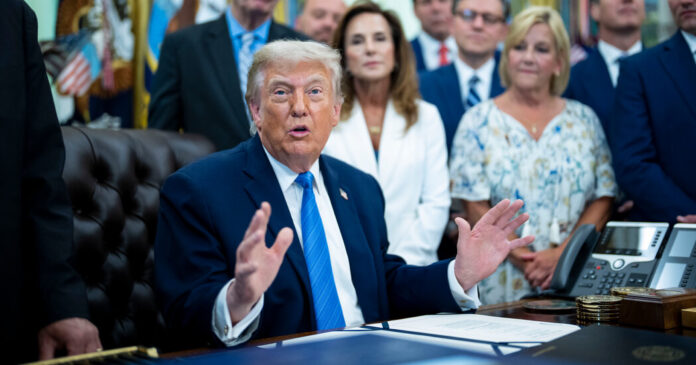
President Trump is addressing the media from the Oval Office, for a bill signing. So far he’s been riffing on familiar talking points, attacking Democrats and boasting about his refurbishment of the Lincoln Memorial’s reflecting pool.
Trump, who was ostensibly here to discuss an immigration enforcement bill, is deep into a topic that interests him far more: his various renovation, redecoration and refurbishment projects around Washington, D.C. He has been discussing sandblasting, concrete and the removal of garbage.

Hegseth visits Guantánamo Bay amid U.S. tensions with Cuba.
Image
Defense Secretary Pete Hegseth traveled to the U.S. Navy base at Guantánamo Bay, Cuba, on Wednesday as the Trump administration has been increasing pressure on Cuba’s government to make political and economic changes.
The Pentagon said the purpose of Mr. Hegseth’s visit and a stop later in the day at the headquarters of U.S. Central Command in Tampa, Fla., was “to engage with troops.”
Videos released by the Pentagon showed him lifting weights and doing jumping exercises with Marines near the gate leading to Cuba. He also went for a run along a portion of the base, which he called “a very important and strategic piece of American terrain.”
En route, he reposted a remark by President Trump hailing a U.S. blockade against Iran as the most successful “in the history of Naval Warfare.”
During his morning visit, he also warned Cuba against trying to obtain weapons capable of reaching either U.S. soil or the base, in the southeastern portion of the island.
“What happens with the future of Cuba is in the hands of the president of the United States and the leadership of Cuba,” he said. “No matter what, the Department of War is going to be prepared and postured for any possible contingency.”
About two weeks ago, Gen. Francis L. Donovan, the commander of U.S. military operations in Latin America and the Caribbean, met with a senior Cuban military official at the fence line separating the U.S.-controlled territory from the rest of the island. It was the first visit between U.S. and Cuban forces at the base in more than a year.
John Ratcliffe, the C.I.A. director, also traveled to Cuba last month.
The U.S. military base, which is behind a Cuban minefield and secured by a unit of Marines, functions like a small American town, entirely independent of the Cuban economy. It is resupplied by ships and aircraft from the United States, which bring liquefied natural gas from Georgia and food for the commissary and restaurants on a twice monthly barge from Florida.
Mr. Hegseth last visited the base in February 2025 and enthusiastically put a focus on the Trump administration’s plan to house tens of thousands of detainees there as part of its crackdown on immigration. At the time, 26 immigration detainees were being held on the base.
The program, run by the Homeland Security Department and the Pentagon, never expanded. Fewer than 900 immigration detainees have been brought to Guantánamo. As of this week, five migrants were detained there.
It is a sleepy time for the base of about 4,500 residents. The school for sailors’ children is in summer recess, and some families have returned to the United States for vacation. Camp Justice, where the Pentagon holds hearings for some of the 15 wartime prisoners held there, is closed until early August.
In Tampa, he thanked military and civilian forces for their contributions to the conflict with Iran, noting it had passed the 100-day mark “from major combat operations to the cease-fire to the blockade.” Central Command is headquarters for military operations in the Middle East.