
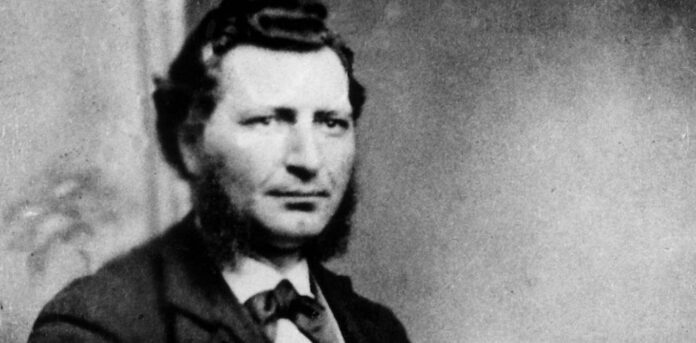

Nov. 16 marked the 140th anniversary of Louis Riel’s execution at the age of 44. Riel was the political and religious leader of the Métis and defender of the territorial and cultural rights of his people in the Canadian Prairies.
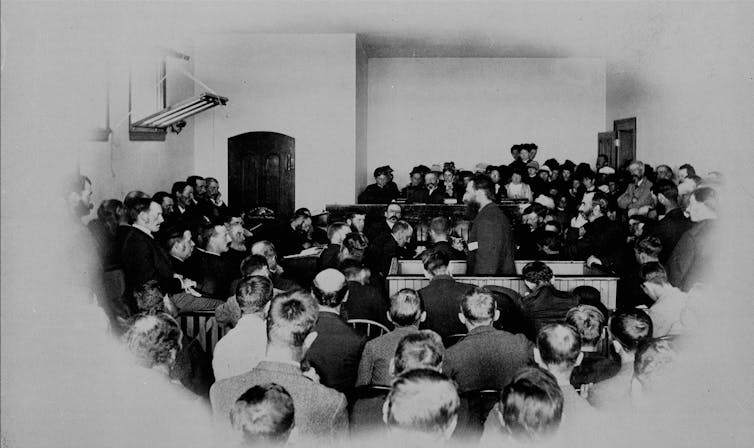
Riel was tried for treason following the North-West Rebellion of 1885, but his death can’t be reduced to a mere historical event. Rather, it provides an opportunity to revisit a defining moment in modern Canadian history and to assess how the issues he raised — sovereignty, land rights and cultural pluralism — remain deeply relevant to this day.
Far from being confined to archives or history books, Riel regularly reappears in political debates, artistic creations and discussions of Canadian identity.
As director of the Centre for Canadian Studies at Stockholm University, I have noticed students’ interest in issues related to multilingualism in Canada, particularly the creation of the Canadian Confederation. One of my areas of research concerns Indigenous cultures’ struggle for visibility..
A voice for those seeking autonomy
Riel occupies a unique place in Canada’s collective memory. Born into a community that emerged from the intermingling of Indigenous Peoples and European settlers, he became the spokesperson for a distinct cultural space, attached to its lands, traditions and language.
In the Red River Rebellion of 1869 and then in the North-West Rebellion of 1885, he defended the legitimacy of the Métis people who were seeking to preserve their autonomy amid state expansion towards the West.
Behind the military conflict were two opposing views of the country. One was the vision of a national construction project centred on strong federal power and a colonial model of land management. The other was a conception rooted in linguistic plurality, the recognition of Indigenous Peoples, and local governance.
The recognition of cultural rights
Unlike other major political figures, Riel never published a book. However, he did leave behind an impressive collection of manuscripts, memoirs, letters, religious reflections and political texts.
His prison writings, the 1885 Memorial on Métis Rights, as well as documents associated with the Exovedate movement, testify to his rich and complex thinking. The Exovedate was a political council formed around Riel in 1874 and tasked with guiding his religious and national actions as well as reflecting on the political future of the Métis.
These writings reveal a man who was convinced that the Métis could participate fully in the creation of a Canada that respected cultural differences, provided that their rights were recognized in an equitable manner. His work also reveals someone deeply marked by political isolation, often misunderstood by federal authorities and even by some of his own supporters.
The living legacy of the Métis today
This textual legacy continues to influence the thinking of Canada’s Métis, whose political position has evolved significantly in recent decades. Constitutional recognition, legal advances in territorial rights, the structuring of provincial Métis organizations and the linguistic revival of Michif gives new meaning to the aspirations of Riel in the 19th century.
For many, his life and actions serve as a reminder that Métis rights are a historical reality in the Canadian Prairies. Contemporary claims concerning land, natural resources, local governance and institutional representation are a direct continuation of the debates in which Riel was involved.

Riel’s role in popular culture
Riel’s return to the national conversation is also visible in popular culture where film, literature and the visual arts regularly reinterpret his image.
The film Universal Language offers a recent and striking example. This film by Matthew Rankin, shot in Manitoba in Farsi, presents a political and linguistic fable in which Métis history and memory become the driving forces behind an inventive reflection on minority languages and cultural resistance.
Riel appears as a figure of cultural resistance, a symbol of the fragility of minority languages and the resilience of marginalized communities. The film captures how Riel has become a visual and narrative reference point for reflecting on the relationships among language, power and belonging.
In other works — whether graphic novels, artistic performances or plays — the figure of Riel appears in turn as a visionary, a political martyr or a misunderstood actor of his time. His execution, long presented as the punishment of an armed rebel, is now interpreted in light of the structural injustices that have marked the history of relations between the Canadian state and Indigenous Peoples.
The territorial rights of the Métis
One reason Riel continues to fascinate Canadians is that the questions he raised remain unanswered. The relationship between Indigenous sovereignty and the Canadian federal framework is still at the heart of contemporary discussions on modern treaties and self-government. Land issues, which had triggered some of the tensions in the Prairies, are returning in current disputes over Métis land rights.
The language issue, whether it concerns the place of French or Indigenous languages, is part of a broader reflection on Canada’s ability to protect its characteristic cultural diversity. And finally, Riel’s place in public commemorations reveals the extent to which the country continues to debate its own national narrative.
Belated national recognition
Canada was slow to officially recognize Riel’s contribution. It was not until 2019 that Parliament officially designated Nov. 16 as Louis Riel Day, marking a more nuanced reinterpretation of his political role. The province of Manitoba, which has long honoured him with a provincial holiday and different official commemorations, had already recognized his essential historical contribution.
This recognition is part of a broader process of re-evaluating the colonial past and acknowledging the injustices done to Indigenous Peoples. In this context, Riel becomes a mediator between memory and the present; a starting point for better understanding how the country was built and how it could evolve.
Read more: 5 vital leadership takeaways from the life of Chief Poundmaker
Commemorating the 140th anniversary of his execution means questioning the very foundations of contemporary Canada. Riel embodied a vision of the country based on dialogue, plurality and recognition of Indigenous political entities. Revisiting this vision means asking whether today’s Canada is capable of giving a real place to the Métis, First Nations and Inuit.