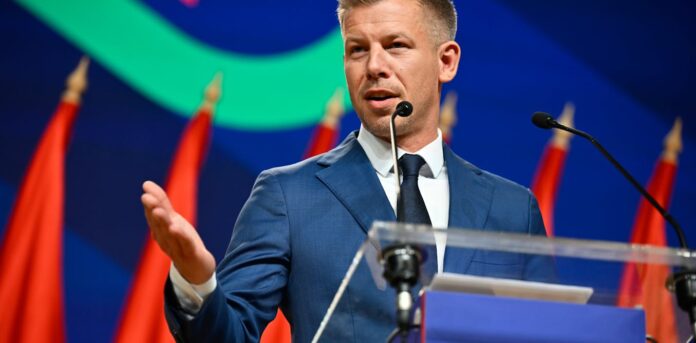

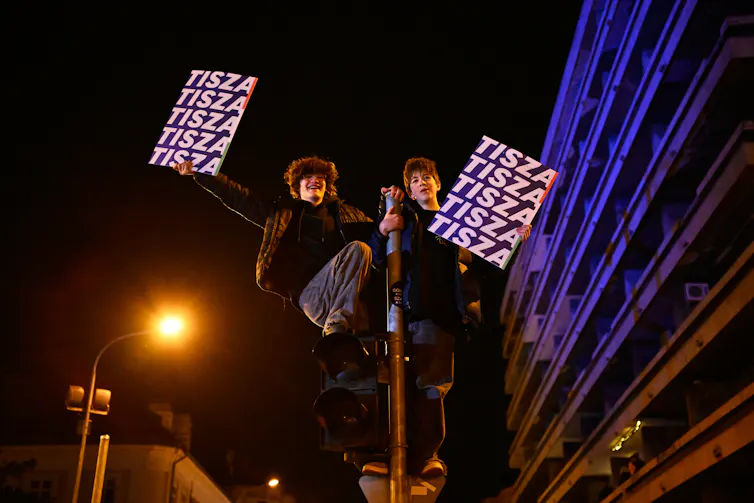
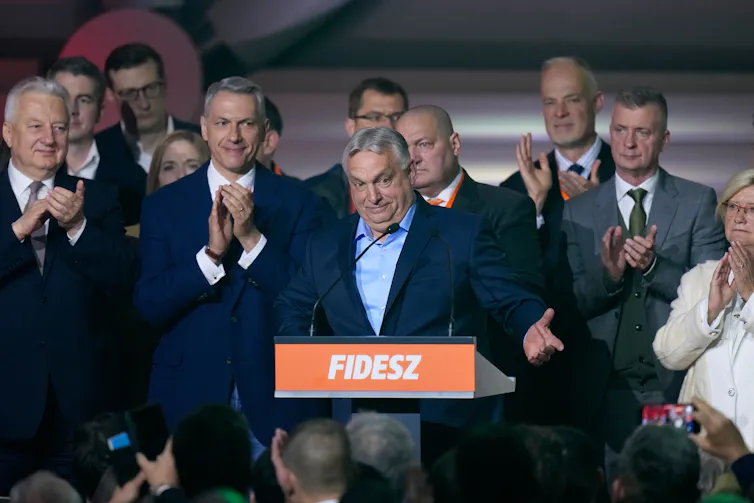
Hungary recently put an end to 16 years of Viktor Orbán’s rule when Péter Magyar’s Tisza party defeated him, winning a majority government in the country’s general elections. The result marks a major political turning point that’s likely to redefine the country’s institutions and its relations with the European Union, Russia, Ukraine and the United States.
Hungary’s political transition is not merely a change of government. It marks the beginning of a period of uncertainty about the direction the country will take in the future.
As an associate researcher at the Raoul-Dandurand Chair of the Université du Québec à Montréal and a specialist in international relations, I analyze politics in central Europe and issues relating to new technologies.
Links to power
Péter Magyar’s victory is partly explained by his career path. The leader of Tisza (Respect and Freedom Party), Magyar had worked within Orbán’s Fidesz party for 20 years, starting in the 2000s. After Fidesz won Hungary’s elections in 2010, Magyar held various posts within the Ministry of Foreign Affairs, then at Hungary’s Permanent Representation to the European Union and finally in Prime Minister Orban’s office in 2015.
Magyar severed ties with Fidesz and joined Tisza in the middle of a political crisis in 2024, sparked by Orbán’s decision to grant a presidential pardon to a former deputy director of a children’s home who had been convicted for covering up his superior’s actions in a child sex abuse case in 2022. Added to that, there were also allegations of corruption at the highest levels of government.
Tisza is a member of the European People’s Party (EPP), the European Union’s main centre-right political group. This group includes, notably, Chancellor Friedrich Merz’s German CDU-CSU and Prime Minister Donald Tusk’s Polish Civic Coalition. It should be noted that Fidesz was also a member of the EPP until it left the group in 2022.
These factors suggest that Magyar is not a longstanding opponent of Fidesz but, instead, opposes what the party has become. This is likely what explains his victory: he proposed a return to Fidesz’s political platform of 16 years ago. The core of his program centres on the fight against corruption and crony capitalism.
Constitution and immigration
Having a constitutional majority gives Tisza the power to amend the Hungarian constitution, which was adopted in 2011 and was subsequently amended several times by the Orbán government. It’s too early to know exactly what changes Tisza will make, but they will likely include becoming aligned with the European Union over the issue of the balance of powers.
On social issues as well, Tisza’s positions have yet to be defined. On immigration, Magyar takes a firm stance similar to Orbán’s: he embraces a strict policy of control over migration flows and stands for protecting national interests with measures that include restrictions on the entry of new migrants.
Read more: Why many of Hungary’s religious groups will be celebrating Viktor Orbán’s election loss
Distancing himself from Russia
Foreign policy is one of the most important aspects of Magyar’s program. Under Orbán, Hungary had established itself as one of the EU member states closest to Moscow, repeatedly blocking European initiatives, particularly on the Ukraine issue. Magyar intends to break with this and align Budapest more closely with other European capitals.
One of the immediate challenges is to restore relations with European institutions in order to release funds that were frozen as a result of tensions between Brussels and Budapest, which are estimated at over 6 billion euros. Hungary is one of the main net beneficiaries of the European Union budget.
However, this alignment with the EU may not be absolute. In the European Parliament, Tisza has tended to vote the same way as Fidesz on a number of issues, particularly on migration matters. On Ukraine, Tisza’s positions are still ambiguous: Magyar opposed accelerating Ukraine’s accession to the EU, but supported lifting the Hungarian veto on European aid to Kyiv, estimated at 90 billion euros.
There will also likely be a revival of the Visegrad Group, known as the V4, including a rapprochement with Poland under Polish Prime Minister Donald Tusk, who has supported Magyar.
The V4, a co-operation framework between Poland, the Czech Republic, Slovakia and Hungary, is an informal platform designed to promote central European positions within the European Union. Weakened since 2022 by differences between Warsaw and Budapest over the Russian issue, the group could regain a degree of cohesion with Tisza in power.
Read more: Orbán’s downfall is a positive for EU-Hungary relations – but the reset will not be smooth
Open to alliances, but defending sovereignty
When it comes to relations with the U.S., Magyar intends to maintain close ties with Washington. During Vice-President JD Vance’s visit to Hungary to support Orbán, Magyar stated on his X account that his government would view the United States as a key partner, both as a NATO ally and an economic partner.
However, he also stated that “Hungary’s history is not written in Washington, nor in Moscow, nor in Brussels.” This sums up his international political vision well.
Ultimately, Hungarian government policy is likely to adopt a broadly pro-European diplomatic line, but one marked by a desire to preserve national room for manoeuvre, which could lead to continued disagreements with Brussels.