

Fossil fuel-dependent communities in Western Canada sit at the centre of Canada’s energy decisions. A just and inclusive clean energy transition will depend on how well governments listen to these communities and how fast they deal with the forces working to slow down energy decarbonization.
When it comes to the energy transition, public discussion tends to focus on emissions targets and policies to achieve them. These are important, but they’re just one aspect of the issue. In the oil- and gas-producing regions of Western Canada, conversations and concerns centre on livelihoods, identity and a nagging doubt: does anyone in power grasp rural realities?
Our ongoing research across the region — based on large citizen surveys, focus groups with municipal leaders and analysis of disinformation — highlights that emotions, narratives and perspectives of communities sit at the heart of Canada’s energy transition politics. As we mark the United Nation’s International Day of Clean Energy today, these voices demand attention before divides deepen further.
Focus groups with municipal staff from 10 oil- and gas-producing communities in British Columbia and Alberta revealed a delicate balancing act. They’re actively pursuing diversification — geothermal projects, hydrogen pilots, tourism expansion, data centres, manufacturing hubs, even rare-earth mineral processing — but most of these efforts build around, rather than beyond, oil and gas.
For many communities, the industry isn’t just jobs. It’s the economic engine funding hospitals, schools, arenas, roads and the very existence of their towns. Abstract talk of an energy transition can feel threatening when it overlooks this.
An Alberta official captured the fear bluntly:
“If you took oil and gas out of our community, I would suggest that there would be no hospital. There would be no schools. There would be no town. The only reason our community exists is to service the oil and gas industry.”
Deep emotional divides
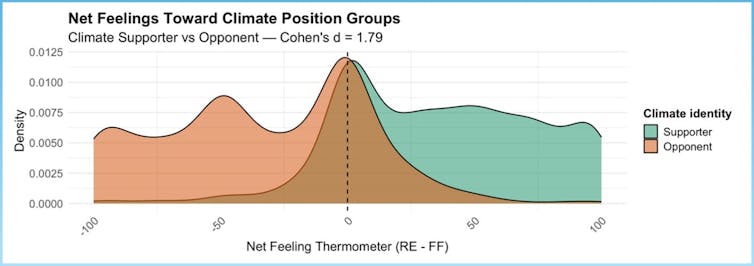
Our 2025 survey of 3,400 residents in non-metropolitan communities across British Columbia, Alberta, Saskatchewan and Manitoba helps explains why climate policy ignites public backlash.
Affective climate polarization, which describes the emotional distance between those who support and oppose climate policy, rivals partisan left-right divides in intensity. These emotional climate identities help explain differences in support for climate policy that ideology alone can’t capture — particularly on the political right, where views on climate action are more diverse.
Policy design nuances are critical but complicated by affective polarization. Clean technology mandates and renewable electricity requirements tend to draw broader backing than carbon taxes, which are generally less popular and spark fierce resistance from right-leaning citizens.
Bundling climate policies with just transition measures, such as government-funded training for new jobs, community-owned energy, low-carbon incentives and public transit, can boost support for carbon pricing among the less polarized. However, for those with stronger emotional commitments, these just transition supports are often ineffective and can even trigger backlash.
Climate policy details matter less to people who score high on affective climate polarization. This helps explain why climate policy debates remain so deeply politicized: when emotional attachments to climate identities are strong, people respond more to elite cues and identity-based judgments than to policy design itself.
Municipalities grapple with limitations
Municipal officials battle structural voids. Officials in northeastern B.C. and Alberta juggle economic ambitions and governance limitations. They craft economic strategies and chase low-carbon investments, while being hamstrung by thin staffing and permitting delays stalling projects for years.
The sharpest barrier to the clean energy transition is the absence of coherent, regionally tailored visions from other levels of government. Federal clean growth plans promote critical minerals and hydrogen. Provincial strategies mix liquefied natural gas with renewables.
Locally, these strategies ring hollow — they seem contradictory and urban-centric. A municipal official in B.C. we spoke to decried a “one-size-fits- all” approach, citing propane-powered electric vehicle chargers in -40 C winters: “How do you gain the support … when even the province isn’t actually addressing” regional realities?
We’ve found that public attitudes differ by age, with youth embracing climate sustainability but veterans of oil-tied lives viewing transition as a “hard sell.” Without a common vision recognizing municipal governance limitations, community leaders hesitate on bold plans, wary of backlash in towns deeply connected to the promise and precarity of oil’s boom–bust cycles.
These tensions are being wilfully intensified by the fossil-fuel industry’s propaganda machine, which uses bad-faith arguments to suggest that climate policies and fossil-fuel communities are at odds.
Read more: Fossil-fuel propaganda is stalling climate action. Here’s what we can do about it
These arguments often ignore the potential for a well-managed energy transition to improve public health, foster regional development and increase community resilience in these regions.
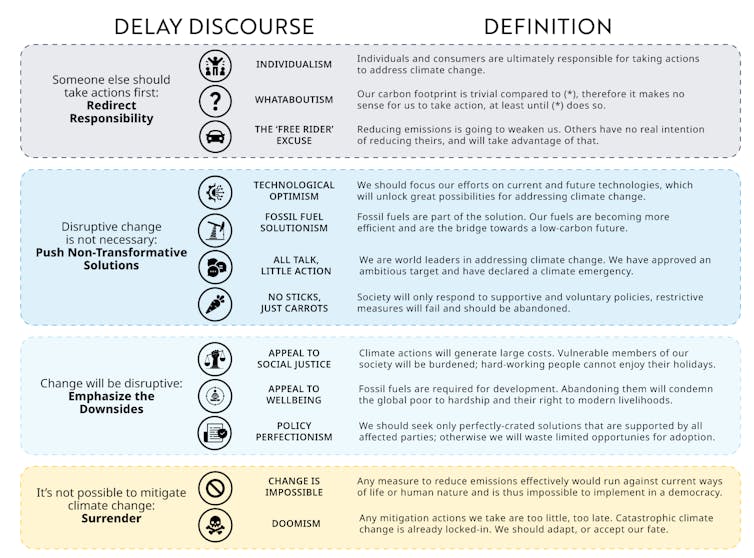
These are not the only narratives the fossil-fuel industry is using to slow climate action. Our research on Canada’s climate delays shows that fossil-fuel propaganda is being used to falsely portray Canadian oil as low-emissions, to urge Canada to wait for others to act first and to claim that climate policies are more detrimental to workers more than climate change.
Fostering a just energy transition
Governments must engage in genuine listening. Fossil-fuel communities aren’t barriers, but key participants in all energy transition risks and benefits. Co-creating policies with them rather than imposing top-down visions can help grow jobs, revenues and services in Western Canada.
Engagement with communities must also be emotionally attuned. Overcoming climate polarization means restoring trust via local messengers, consistent follow-through and deliberative forums like public assemblies.
At the same time, governments must confront misinformation and propaganda. They can step in with policies that challenge disinformation legally, regulate ads and fund community energy transformations beyond fossil fuel extraction.
The International Day of Clean Energy spotlights promise. In Western Canada, it also spotlights peril. The energy transition’s success hinges on centring fossil fuel communities as protagonists, not peripherals — turning the transition into a shared opportunity.