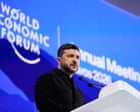

Volodymyr Zelenskyy has taken aim at Europe in a fiery speech at Davos, accusing leaders of being in “Greenland mode” as they waited for leadership from Donald Trump on Ukraine and other geopolitical crises rather than taking action themselves.
The Ukrainian president’s call to arms, targeting some of Kyiv’s top allies, capped a week of extraordinary diplomatic drama at the World Economic Forum in the Swiss ski resort, where European leaders scrambled to end a standoff with the White House over Greenland, and several western leaders – led by Canada’s Mark Carney – called for stronger pushback against Trump’s territorial ambitions and political whims.
Zelenskyy used his speech to demand greater pressure on the Kremlin, as Trump dispatched his envoy Steve Witkoff to Moscow to meet Vladimir Putin on Thursday in the latest effort to advance peace talks between the two countries.
Despite Trump’s limited and scattershot support for Ukraine since taking office one year ago, Zelenskyy focused instead on Europe’s role in the conflict, accusing the continent’s leaders of complacency and inaction.
“Just last year, here in Davos, I ended my speech with the words ‘Europe needs to know how to defend itself’,” Zelenskyy said. “A year has passed, and nothing has changed.”
He added: “Europe remains in Greenland mode: maybe someone somewhere will do something.”
Zelenskyy’s speech nodded toward the extraordinary demands by Trump for the US to take over Greenland, but largely eschewed criticism of the US president, instead blaming Europeans for remaining at the behest of an increasingly unpredictable White House.
He delivered his speech as Ukraine endures a bitter winter, with Russian attacks on civilian infrastructure cutting power and heating to much of the capital, Kyiv, as well as other major cities.
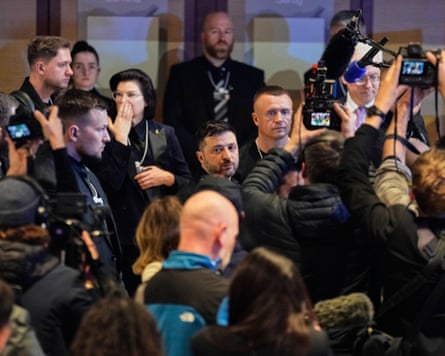
Headlines and talks during the annual gathering of world leaders and financial heavyweights have been dominated by Trump’s demands to take over Greenland and then his announcement of the “future framework of a deal” that would allow the US access to Greenland “for ever”.
Zelenskyy said: “Everyone gave attention to Greenland, and it is clear most leaders are not sure what to do about it. It seems like everyone is just waiting for America to cool down on this topic, hoping it will pass away. But what if it [does] not: what then?”
Some European leaders have echoed those sentiments, with Poland’s Donald Tusk calling Greenland an “unneeded” distraction from Russia’s war in Ukraine and efforts to disrupt Europe.
Ireland’s Micheál Martin said European leaders “cannot lose focus on the situation in Ukraine”, calling the situation “desperate”, but crediting the US with a “critical” role in achieving “a just and fair and sustainable peace in Ukraine”.
Zelenskyy said: “Sending 14 or 40 soldiers to Greenland – what is that meant to achieve? What message does that send to Putin? To China? And perhaps, most importantly, what message does it send to Denmark?”
During his speech, he suggested Ukraine could help defend Europe in the event of a Russian invasion of Greenland, saying: “We know what to do if Russian warships go near Greenland, Ukraine can help with that. They can sink near Greenland just as they do near Crimea.”
Zelenskyy said Europe should play a more muscular role in targeting Russia’s “shadow fleet” of oil tankers, which help bankroll its war machine, and said it remained too easy for Russia to bypass sanctions and to continue mass-producing missiles and other ordnance.
The threats to Europe were existential for Nato, he said, and Europe needed a “united armed forces” that could defend the continent.
“Today, Europe relies only on the belief that if danger comes, then Nato will react. But no one has really seen the alliance in action. If Putin decides to take Lithuania or strike Poland, who will respond? Right now, Nato exists thanks to the belief that the United States will act … but what if it doesn’t?”
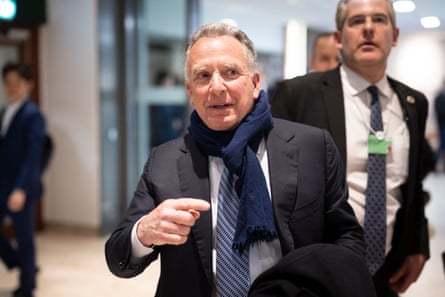
Zelenskyy delivered his speech shortly after he met Trump to discuss stalled talks for a peace deal to end Russia’s war in Ukraine.
Trump told reporters that his meeting with Zelenskyy was “good” but that there was “a ways to go”. Witkoff, who met Putin later on Thursday, said the fact that the meeting was called by the Russians was a good sign.
“I think we’ve got it down to one issue and we have discussed iterations of that issue, and that means it’s solvable,” Witkoff said before flying to Moscow. He was joined by Trump’s son-in-law Jared Kushner.
Trump, when asked at Davos whether he had a message for Putin, said: “The war has to end.”
Putin greeted the Americans shortly before midnight in Moscow. Minutes after the talks began, Russia said it had carried out a patrol of strategic bomber planes – something it regularly does as a show of strength and deterrence.
The defence ministry said the Tu-22M3 bombers – part of a long-range fleet that Russia has used throughout the war to fire missiles at Ukrainian cities, military targets and energy infrastructure – flew for more than five hours over the Baltic Sea, escorted by fighter jets.
On Thursday Trump launched his international “board of peace”, established to manage a peace process in Gaza. Critics have said the ill-defined board appears to be a shadow United Nations.
Ukraine, along with Russia and Belarus, has been invited to join the initiative but has so far demurred.
“For us, it’s understandable that we will be on this board when the war will end,” Zelenskyy said. For now, “we are enemies [with the Russians]. Belarus is an ally of the Russians. We can’t be with them.”
After Witkoff’s meetings at the Kremlin, Ukraine, Russia and the US will hold three-way talks in Abu Dhabi this weekend, marking the first time that the three countries have sat down together since Russia invaded in 2022. It was not clear whether the meetings would be held through shuttle diplomacy with the US acting as intermediary.
“It will be the first trilateral meeting in the United Arab Emirates,” Zelenskyy said, without giving details on who would be attending from each country. “I hope [the] Emirates know about it. Sometimes we have such surprises from the American side.”
On the trilateral meeting, Trump said late on Thursday: “Anytime we meet, it’s good.”
While the US has said that a deal is within reach, Zelenskyy was less bullish, saying that Russia had to be “ready for compromises … not just Ukraine”.
“We will see what the result will be,” he said. “It’s better than to not have any kind of dialogue.”