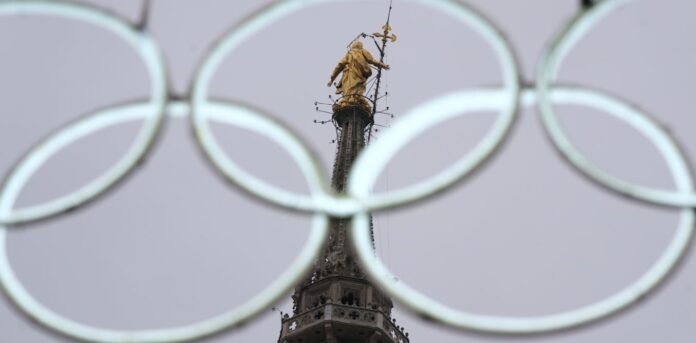

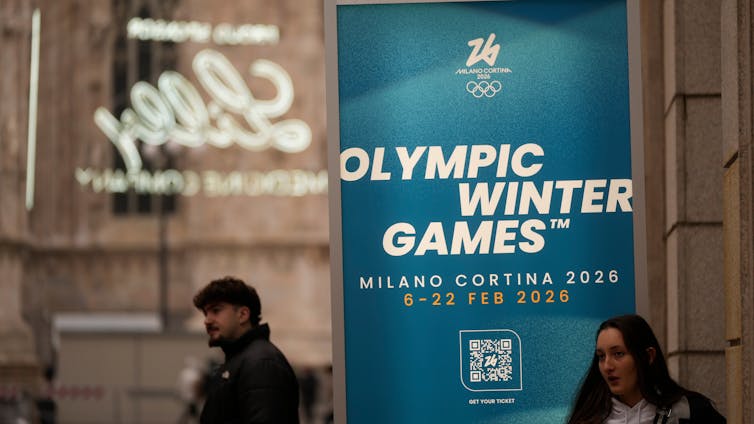
This winter’s Olympic games will not be a normal international sporting event. A cloud of geopolitical tension looms over the Milan Cortina Winter Olympics, as well as the upcoming FIFA Men’s World Cup.
The tension escalated after Prime Minister Mark Carney’s speech at the World Economic Forum, where he spelled out his vision for a new world order for middle powers. It stood out starkly against United States President Donald Trump’s own speech at Davos, where he continued expressing his interest in acquiring Greenland from Denmark.
As a result, the 2026 Winter Olympics will likely disrupt the International Olympic Committee’s stated goal of sport bringing the world together under one banner in unique ways. Rather than muting political conflict, the Games may amplify it.
The politics behind Olympic host nations
The unifying mission of the Olympics already sits uneasily alongside previous debates over the morality of hosting the Games in repressive states. For decades, critics have argued that such regimes use the Games to improve their global image and advance their political and economic goals.
International sports events provide widespread media coverage and brand exposure. That spotlight is particularly attractive for authoritarian and repressive regimes seeking legitimacy on the world stage.
Access to a western audience provides these states with the opportunity to “sportswash” their legitimate authority through a carefully curated image.
Read more: How repressive regimes are using international sporting events for nation-building
Repressive regimes have increasingly pursued this strategy. Research shows that the share of international sporting events hosted by autocracies fell from 36 per cent in 1945-88 to 15 per cent in 1989-2012, but has rebounded to 37 per cent since 2012.
Sportswashing and the Olympic bargain
Sportswashing involves the use of sport to redirect public attention away from unethical conduct. In the case of international sporting events, the aim is typically to improve the reputation of the host nation by using the immense popularity of sport to “wash” away scrutiny linked to human rights abuses or democratic backsliding.
Sportswashing can also work to establish broader global acceptance of repressive regimes, particularly when western institutions accept their wealth and acquiesce to their goals.
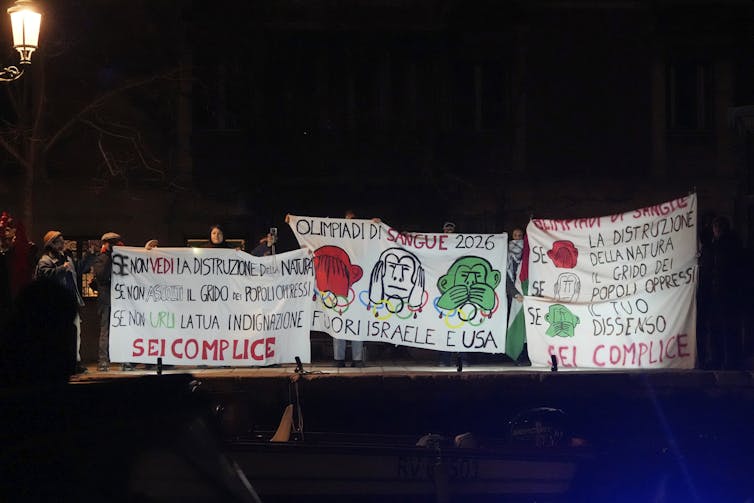
International sporting organizations also stand to gain from this arrangement as well. Authoritarian hosts are more likely to acquiesce to demands to build costly, single-use sport facilities, as they do not face the kind of democratic backlash that could arise after using public funds for an event that carries little public benefit.
In some cases, these regimes have even been willing to bribe officials to gain the votes necessary to win bids to host these sporting events.
From sportswashing to nationalism
There is often a symbiotic relationship between repressive regimes and international sporting organizations. However, the Milan Cortina Games are unlikely to serve up the sportswashing narratives we have seen recently. Instead, the political stories of the 2026 Winter Olympics are likely to be more explicitly nationalist.
Sport is a powerful vehicle for national rhetoric. It can reinforce a person’s social identity or how they see themselves in relation to others by encouraging people to see themselves as a member of a team or country, and celebrating victory as a collective success or interpreting defeat as a symbolic loss.
Sport also possesses powerful symbolism that can be exploited to great affect in forming a coherent national identity. In this way, sporting events can reinforce national identity as an objective symbol that connects to primitive forms of national ideology.
Political tensions heading into Milan Cortina
In the lead-up to the 2026 Winter Olympics, a series of geopolitical flashpoints has intensified political tensions surrounding the Games. These include the U.S. invasion of Venezuela, Trump’s desire to annex both Greenland and Canada and his ongoing trade disputes with traditional allies.
Whether it’s tension between the European Union and the U.S. or between Canada and the U.S., there are many story lines that can serve as galvanizing moments for nationalist rhetoric.
The 4 Nations Face-Off, won by Canada a year ago, demonstrated how quickly Canada and the U.S. can mobilize Canadian nationalism amid tense trade negotiations. Any Olympic ice hockey matchup between the two countries will feed into the national imagination of both countries and their political leaders.
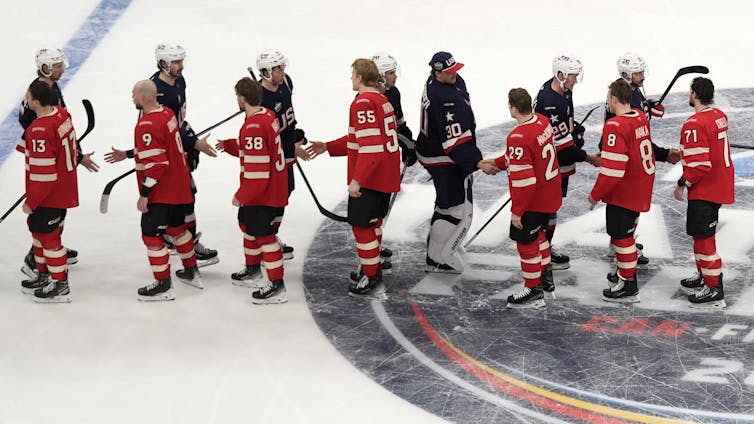
Denmark and the U.S. are also in the same group in the men’s ice hockey tournament, meaning they are guaranteed to play each other in the round-robin phase.
The men’s ice hockey tournament at the 1980 winter Olympics in Salt Lake City, Utah, served as a pivotal moment in the Cold War. When the underdog U.S. beat the favoured Soviet Union Red Army team, it was deemed the “Miracle on Ice.”
Given Trump’s threats against Greenland, a Danish territory, the Olympics matchup between the two teams could serve as Denmark’s own “miracle on ice” moment.
A medal table ripe for political spin
Beyond ice hockey, this is shaping up to be a Winter Olympics the U.S. is likely to perform quite well in. Traditional winter powerhouses Norway and Russia are both facing scandals or exclusion.
Norway, the all-time leader in medals in Winter Olympics history, is facing a massive cheating scandal in ski jumping but is generally a powerhouse in the nordic sports and skiing events. Russian athletes remain barred from competing under their national flag due to the war in Ukraine and are only permitted to participate as vetted Individual Neutral Athletes.
Trump is likely to make a big deal about any strong American performance, framing any success in contrast to both the EU and Canada.
During his second term in office, Trump has welcomed numerous athletes to the White House and publicly linked sporting success to national strength. He celebrated American participation at the Ryder Cup golf tournament and the 4 Nations Face-off, even when those contests ended in U.S. defeats.
A successful Winter Olympics could therefore provide political capital at a sensitive moment. Amid his attack on Venezuela and stated goal of acquiring Greenland, major soccer countries and EU powerbrokers — including France and Germany — have started to tentatively reconsider their participation in the 2026 Men’s World Cup, hosted in large part by the U.S.
But first, the 2026 Winter Olympics will serve up a menu of matchups that stand to serve the nationalist goals of Trump, Carney and leaders across the European Union.