
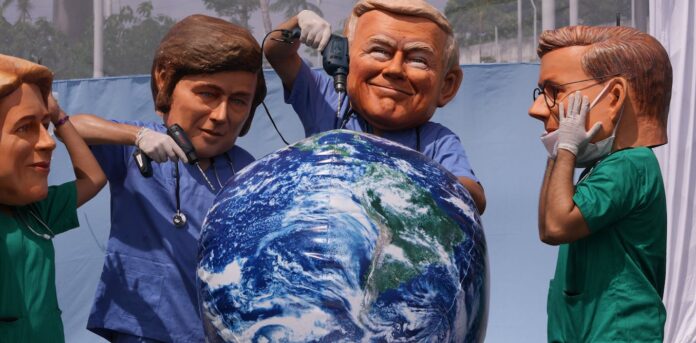

At the recent World Economic Forum in Switzerland, Canadian Prime Minister Mark Carney proclaimed “a rupture” in the global “rules-based order” and a turn to great power rivalry.
While its demise is not certain, even the current disruption to global order, largely due to the Donald Trump administration in the United States, promises profound impacts on the global response to climate change. The world is at risk of losing even the insufficient progress made in the last decade.
But it’s unclear what that effect will be. That uncertainty is both a cause for concern and a source of hope. The climate crisis is not slowing, and humanity must figure out how to navigate the disruption.
Read more: Venezuela attack, Greenland threats and Gaza assault mark the collapse of international legal order
Unfortunately, much of what we know about how climate politics works has depended on a relatively stable rules-based order. That order, however problematic, provided institutions like the United Nations Framework Convention on Climate Change and the Paris Agreement.
It also established trade rules for energy technology, co-operative agreements on public and private climate finance, and parameters for how civil society and states interact. It structured the opportunities and obstacles for acting on climate change.
Everyone who cares about climate action must now grapple with how climate politics can function in a new world of uncertainty. It won’t be easy.
But, to inject a slight note of hope, I’m not convinced that meeting the climate challenge is harder now. It’s difficult in a different way. Let’s be clear: the rules-based order was not producing effective global co-operation on climate change.
Limited successes of the rules-based order
The U.S. has consistently been an obstacle to global climate action. As Carney noted, under the the rules-based order “the strongest would exempt themselves when convenient.” Clearly the U.S. decided from very early on that a stable climate was not a public good it was willing to seriously support.
The U.S. failed to see benefits from climate action that outweighed the perception of costs and has consistently been influenced by status quo, fossil-capital economic interests.
That’s not to say there was no progress under the old rules-based system. At least five sources of progress are worth highlighting:
-
A coalition of the ambitious, mostly anchored in Europe, consistently pushed for action. This coalition stayed in the Kyoto Protocol and took action domestically, moving forward on emissions reductions and globally significant technological innovation.
-
The changing political economy of renewable energy has drastically decreased the costs of wind and solar power.
-
The growth of municipal, sub-national and transnational efforts expanded the reach of climate action while also maintaining some momentum in countries, like the U.S., that were reluctant to move aggressively.
-
Public support and concern over the climate has grown, in part because the increasing impacts of climate change have made it a tangible problem of the present, not future.
-
There’s now a different global architecture for climate governance with the Paris Agreement — one based on collected national actions rather than global collective action. This new architecture was less vulnerable to the first U.S. withdrawal in 2016.
Possibilities for progress
These sources of past progress on climate action could survive the current disruption and play a role in increasing momentum in the global response to climate change. But uncertainties and questions are more plentiful than answers.
A coalition of the ambitious is clearly what Carney’s speech is seeking to catalyze among middle powers. He was not talking about climate change, but a commitment to climate action could and should be a cornerstone that a new order is built upon. This may even attract one of those competing great powers that he alluded to — China. Will China see climate leadership as a means to enhance its global position?
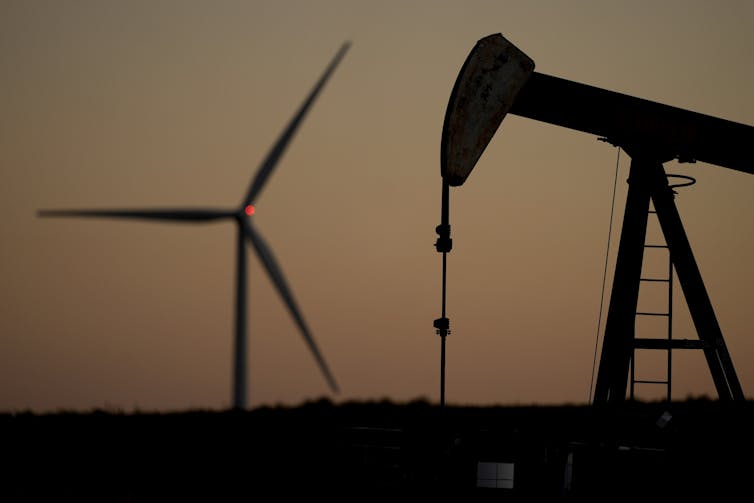
The political economy of renewable energy has momentum that is at least somewhat insulated from the current disruption. How insulated it remains depends on a number of uncertainties.
What will trade rules and practices look like moving forward? What happens within the fossil-fuel energy sector as the U.S. continues to engage in resource imperialism? How will resource competition and co-operation in the renewables sector (over critical minerals, for example) play out moving forward?
Can experimental efforts be a source of resistance and change within the U.S., especially among individual states? And can they play the same role that they did previously, catalyzing further innovation and public support?
Public support for climate action in this new era will likely vary wildly by country. How will growing dissatisfaction with the status quo play out as it intersects with increasingly severe climate impacts?
This could generate further support for right-wing populism. However, affordability and inequality concerns could also become the foundation for building support for climate action and a just transition.
Does the Paris Agreement survive this? It could become a backbone institution for the coalition of the ambitious. The U.S. is gone, again. Maybe other recalcitrant governments should be sidelined from multilateral climate efforts as well, and those willing to act can proceed.
If full global co-operation around climate change is no longer even a façade of the possible now, then the imperative to bring everyone along at each step in the process may evaporate.
None of the ways forward I’ve laid out here are easy. Even if the positive possibilities materialize, they do not guarantee decarbonization and a just transition that is fast and effective enough to matter; to head off the worst of climate change.
What is clear, though, is that like Carney, climate scholars and activists may need to let the fiction of the global rules-based order go. It was not working either in addressing climate change or enhancing justice. Perhaps its disruption is an opportunity to build better foundations for a just and effective global response to climate change.