

A year ago this month, Canadians delivered a result that seemed impossible just a few weeks earlier: another Liberal minority government, this time under newly chosen leader Mark Carney. Now, after winning three byelections, the Liberals have a majority for the first time since 2019.
It’s been an astonishing reversal of fortune for the Liberals. For more than two years, the Conservatives had held a comfortable advantage in the polls. Many analysts treated a Conservative victory as all but inevitable.
Yet on election night on April 28, 2025, the Liberals finished with 43.8 per cent of the vote, edging out the Conservatives at 41.3 per cent, while the NDP and Bloc Québécois dropped sharply from their 2021 levels.
Two major developments upended what had appeared to be a predictable political landscape — and, if the byelection results are any indication, their effects may be lasting.
The first was the return of Donald Trump to the United States presidency. This brought an immediate wave of tariffs and an adversarial posture toward Canada. The policy shock had economic consequences, but it also triggered a shift in how Canadians perceived the risks facing the country.
The second development came in early January 2025. Justin Trudeau resigned after intense internal and external pressure. His departure reset the Liberal brand almost overnight.
With Carney newly installed as leader, the Liberals entered the election presenting not continuity but transformation in the face of Trump’s threats about making Canada the 51st American state.
Read more: Canada, the 51st state? Eliminating interprovincial trade barriers could ward off Donald Trump
Trump and tariffs were primary issues
Taken together, these shocks reshaped voters’ priorities. Instead of evaluating parties along familiar ideological lines, many Canadians approached the election as a question of who could best protect the country during an unusually turbulent moment. It seems that a year later, Canadian voters are still regarding the Liberals in this light.
New data from the 2025 Canadian Election Study (CES) has helped illuminate this dynamic. When asked which party was best suited to manage Canada’s relationship with the United States, Canadians across nearly all partisan groups — including those who typically support other parties — chose the Liberals most often (57.8 per cent).
While Liberal and Conservative partisans selected their own respective parties more than 80 per cent of the time, what’s noteworthy is that strong majorities of NDP (71.6 per cent) and Bloc (62.8 per cent) supporters also selected the Liberals.
The significance of this pattern is hard to overstate. The relationship with the U.S. dominated voter concerns during the election. One in five Canadians mentioned the relationship with the U.S., Trump or tariffs as the most important issue in the 2025 Canadian federal election.
This was the second most common response behind general economic concerns, which were closely tied to the U.S. situation. About one in three Canadians said the economy was the most important issue.

Economic stewardship
Historically, Conservatives benefit when voters prioritize economic competence. But in 2025, the turbulence caused by U.S. tariffs did not translate into increased trust in Conservative stewardship.
Instead, a sizable majority of Canadians supported the use of retaliatory tariffs (68.7 per cent), and more Canadians identified the Liberals as the party best able to manage the economy (48 per cent versus 39 per cent for Conservatives).
This shift in perceived competence had profound cascading effects. Strategic voting among NDP supporters, in particular, proved decisive. While partisans typically remain loyal to their own party, 2025 saw an unprecedented number of traditionally NDP voters casting ballots for the Liberals.
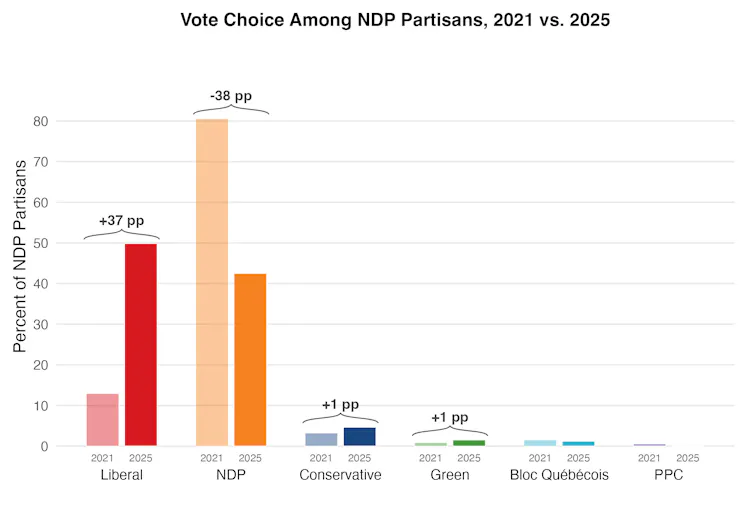
While more than 80 per cent of NDP supporters voted for their own party in 2021, a majority of NDP partisans voted for the Liberals in 2025, a highly unusual pattern for partisans in most elections.
This trend extended to Bloc voters as well, though to a lesser extent, leading to a Liberal minority that was unimaginable six months earlier.

Carney and the Liberals still popular
As we approach the one-year anniversary of this election, the aftermath of those choices is still visible in public opinion.
Polling conducted in early 2026 shows the Liberals holding a six‑point lead in national vote intention, along with a 52 per cent government approval rating. Carney’s net favourability sits at +20.

These indicators, as well as the byelection results, suggest that voters have not experienced the “buyer’s remorse” that sometimes follows strategic elections. Instead, many appear reassured by the combination of stability and technocratic competence they sought in 2025.
Multiple floor-crossings by Conservative and NDP members — the most recent is longtime Conservative MP Marilyn Gladu, whose defection left the Liberals just one seat short of a majority before the byelections — suggest optimism about the Liberal government’s stability.
Whether this stability endures will depend heavily on developments outside Canada’s borders. But for now, Canadians seem broadly satisfied with the strategic choice they made in April 2025.