

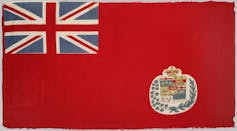
National Flag Day, Feb. 15, marks the 61st anniversary of Canada’s Maple Leaf. Fading in the public consciousness are the debates that accompanied Prime Minister Lester B. Pearson’s proposal to replace the Red Ensign in the 1960s.
Of course, Canada isn’t the only state to have considered changes to its national flag. There are numerous example of flags redesigned to reflect a variety of political agendas.
Flags are treated with reverence in public ceremonies. As we’re witnessing as we take in this year’s Winter Olympic Games, flags brand a nation. They serve as a symbol uniting diverse populations of citizens who share this instant sign of belonging.
Irish political scientist Benedict Anderson referred to these populations as “imagined communities” united by symbols, mass media and myth. Flags are great examples of what British social psychologist Michael Billig refers to as “banal nationalism”. But while flags are often taken for granted, proposals to redesign them can arouse great passion.
Canada versus New Zealand
The Canadian process differed from New Zealand’s, which is interesting since the two cases share so much else in common.
Canada and New Zealand are both British settler states with large Indigenous and immigrant populations. Neither achieved independence by revolution and both retain strong ties to the Commonwealth.
These ties have been reinforced by the First and Second World Wars, when Canadians and New Zealanders shed blood with Great Britain.
Canada became self-governing in 1867, but relied on Westminster to pass constitutional amendments until 1982. New Zealand became self-governing in 1907, but only ended Britain’s role in some legislative matters in 1986.
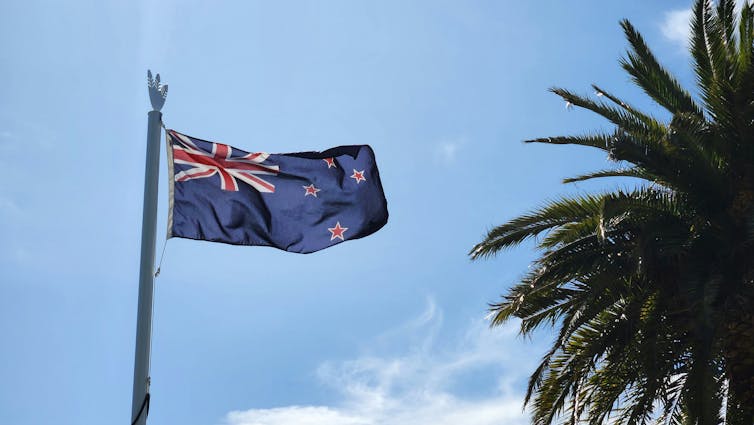
Both countries also experienced a post-war reassessment of their ties to their colonial pasts, evident in the Union Jack occupying the upper left quadrant of each flag. But the efforts to redesign the Canadian and New Zealand flags followed different pathways.
In the case of Canada, the process ended with an entirely new flag. In the case of New Zealand, the status quo prevailed.
Canadian debate
The debate in Canada was dominated by political leaders, accompanied by lively coverage in the media. Conservative John G. Diefenbaker defended the status quo, while Pearson championed a new design.
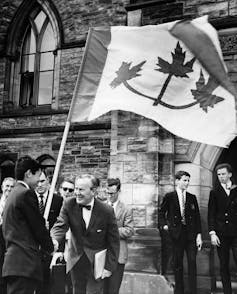
The question was whether the new flag should represent a fresh start or retain symbols of a colonial past. Polls revealed that about half of Canadians wanted a new flag, enough to engage politicians but not enough to establish a clear direction.
Canada’s flag debate, which inspired the longest parliamentary session in history, was the country’s top news story of 1964. Politicians tinkered with designs to appease British imperialists, Québec and those who wanted something new.
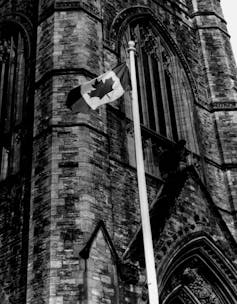
After more than 200 Conservative speeches — and on the recommendation of the 15-member all-party committee — Parliament voted 163 to 78 in favour of the new flag in December 1964.
The flag was raised for the first time on Feb. 15, 1965. When Diefenbaker died in 1979, his coffin was draped with both the Maple Leaf and the Red Ensign, the symbol he fought so hard to keep, perhaps signalling a societal transition.
According to a recent poll, the flag is now the national symbol that Canadians are most proud of (79 per cent).
New Zealand votes
Unlike Canada, New Zealand held a public consultation about its proposed flag redesign involving two referendums in 2015-16.
The rationale for change was similar to Canada’s but also inspired by mix-ups where the New Zealand flag was mistaken for the Australian one. The referendum was promised by John Key’s National Party after it won the 2014 general election.
A public consultation attracted 10,292 designs, including one featuring a Kiwi firing a laser from its eyes.
Voters were asked to select one of five designs in the first referendum held in November and December 2015. The winner, featuring a silver fern and no Union Jack, was then pitted against the official flag in the second referendum held from March 3-24, 2016. Ultimately, almost 60 per cent of voters chose to keep the official flag that had been adopted in 1902.
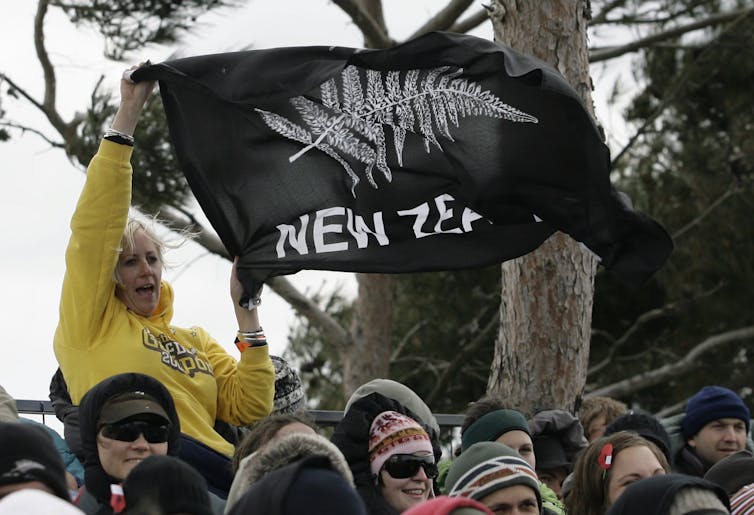
In Canada, there was little consultation with Indigenous Peoples about the new flag.
In New Zealand, Maori voters mainly supported the status quo, partly out of a concern with the connection to the British monarchy, the guarantor of the Treaty of Waitangi. A new flag without a Union Jack could have signalled a step toward republicanism and a weakening of Maori political rights and status.
National identity
In both countries, the chance to change the flag represented an opportunity to reflect on their national identity. The New Zealand process took public opinion seriously, but binary referenda may not be the ideal method for choosing a new flag and turnout was low (67 per cent).
Read more: Next wave: what Australia can learn from New Zealand’s flag referendum
In the Canadian case, it seems highly unlikely that such an important change would be enacted today by a simple vote in the House of Commons. A third option, for any country, would be a citizens’ assembly that could deliberate over a longer period and solicit the views of all community members.
A flag is not just a national garment; it’s the national self-portrait. Debates about designs are debates about who we are and can arouse great passion. Such debates are not trivial — they’re essential parts of the evolving nation-building project.