

As the Donald Trump administration in the United States continues to threaten Canadian sovereignty — including a recent suggestion that Alberta could secede from Canada and join the U.S. — Canadians, like many others in the world, finds themselves in a period of extreme uncertainty.
Trump’s continued violations of the rules-based international order means Canada can no longer rely on its partners to the same extent as it has in the past.
The world must, as Prime Minister Mark Carney recently noted, accept the current climate as it is, rather than looking to the past.
Read more: Mark Carney’s Davos speech marks a major departure from Canada’s usual approach to the U.S.
To do so, Canada must develop a defence policy that can meet the country’s needs. The Canadian government’s recent budget envisions a significant increase in defence spending over the next several years. The problem Canada faces, however, is one that all middle powers face: an inability to compete with great powers in a conventional war.
The Canadian government must therefore pursue non-conventional means to overcome conventional weakness. Simultaneously, the country must be cognizant of the implications of alternative defence policies. The former Yugoslavia provides a harrowing example.
Read more: How could Canada deter an invasion? Nukes and mandatory military service
How to ward off an invasion
The turmoil created by the mercurial American president has caused Canada to examine how it could resist a U.S. invasion in a series of war games. Inevitably, Canada was unable to defeat the U.S. in these exercises, and was forced to rely on unconventional warfare.
Read more: Amid U.S. threats, Canada’s national security plans must include training in non-violent resistance
One way Canada is considering addressing this issue is by creating a civilian defence force and incorporating “total national defence” principles. This development is not completely new; Canada has been considering it for some time.
Read more: Why annexing Canada would destroy the United States
Total national defence in theory
Total national defence is not a new concept. After the Second World War, it became clear to many medium-sized countries that they could not compete with the great powers in a conventional war.
In the 1950s, Yugoslavia spent 22 per cent of its GDP on defence, yet still recognized it was unlikely to defeat a great power in a conventional war. Yugoslavia, and other countries, needed an alternative. Enter total national defence.
The concept of total national defence seeks to mobilize all aspects of society for the war effort. Given the uniqueness of each country, no country’s total national defence system looks the same as the other. What’s important for Canada’s examination, however, is the command-and-control elements of the system.
The biggest vulnerability is the enemy eliminating their command-and-control functions early in the conflict. The U.S., as seen in Iraq in 1991, excels at these types of operations. Russia, while not as effective, attempted to do the same against Ukraine in the early phases of its full-fledged invasion.
For a smaller country to survive such an attack, it needs to ensure that resistance can continue regardless if centralized command is compromised.
Under the theory of total national defence, countries decentralize command and control functions to prevent them being eliminated.
The extent to which countries do so varies. Individual units may operate at the local level without centralized guidance to maintain the struggle against an opponent. In short, even if an opponent succeeds in eliminating the central command of a state, its army and people can continue the struggle.
Canada’s chosen example: Finland
Canada, as it considers implementing such a policy, has looked to Finland for inspiration. Prior to joining NATO, Finland was a relatively small country that could not rely upon allies for defence.
What Canadian officials found in Finland impressed them. Finnish officials have long relied upon extensive joint-use facilities, such as bunkers. It also uses conscription to maintain a strong deterrent.
But Canada and Finland are fundamentally different countries. The persistent threat of Russian invasion has, over time, normalized policies like conscription among the Finnish. Furthermore, and most critically, Finland is, unlike Canada, a unitary state and not a federation.
Canada’s worst-case scenario: Yugoslavia
Much like the former Yugoslavia, Canada is a federation. It has stark regional differences, both in terms of culture and economics.
The divisions in Canada aren’t as entrenched as those in Yugoslavia in the 1980s. Nevertheless, as CSIS recently warned Parliament, the divides are real and outside forces could magnify and exploit them.
U.S. Treasury Secretary Scott Bessent’s recent encouragement of Albertan separatism, and Albertan separatist meetings with Trump officials, are examples of how foreign entities can magnify these divides.
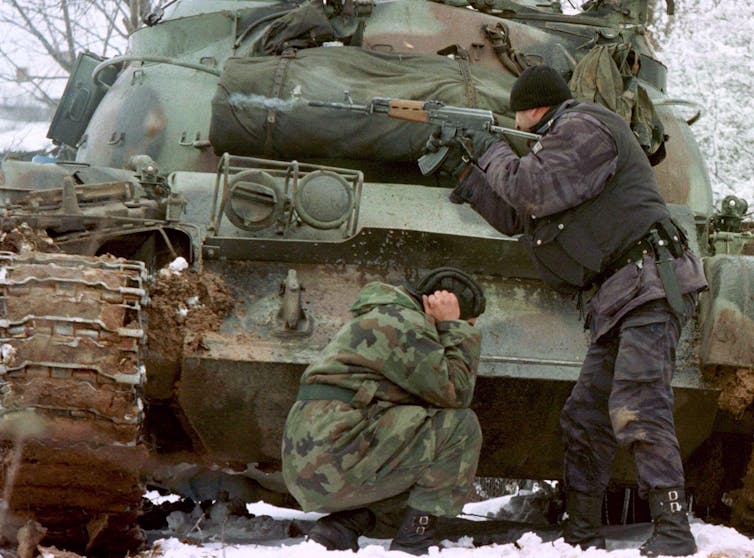
Yugoslavia’s embrace of total national defence relied on the unity of the people to overcome the weaknesses of a decentralized command structure. Without it, not only would the effectiveness of such a defence have been compromised but, more worryingly, separatist forces could have used such decentralized forces for their own purposes.
In fact, separatists did so , using these decentralized defence forces for their own purposes against Yugoslavia. That helped fuel the former country’s conflicts and ultimate dissolution in the 1990s.
Learning from the past
But just because Yugoslavia’s embrace of total national defence and a civilian defence force helped facilitate the breakup of the country doesn’t mean that will happen to Canada. Too often, people assume that history is repetitive.
Instead, the past is an inventory of ideas. Yugoslavia’s embrace of total national defence failed, but Canada can learn lessons about what worked and what will not in a federation, and in doing so improve its own capabilities.
Canada is wise to pursue non-conventional defence strategies. The country, and its defence planners, however, must ensure they’re drawing from the right examples.