


Following the recent shooting of Renee Good by an agent for Immigration and Customs Enforcement (ICE) in the United States, the Donald Trump administration’s latest narrative suggests that “deluded wine moms” are to blame for the violence in ICE-related demonstrations in Minneapolis and across the country.
This mother-blaming is nothing more than an old trick with a new spin.
Organized gangs of ‘wine moms’
Earlier this week, a Fox News columnist wrote that “organized gangs of wine moms” are using “antifa tactics” to “harass and impede” ICE activity. In the opinion piece, he claimed that “confusion” over the what constitutes civil disobedience is what “got 37-year-old Renee Good killed.”
Similarly, Vice-President J.D. Vance called Good a “deranged leftist” while a new acronym, AWFUL — Affluent White Female Urban Liberal — has appeared on social media.
In framing protesters like Good, a mother of three, as confused, aggressive and “delusional,” this narrative delegitimizes and pathologizes maternal activism. This strategy aims to divert blame from the U.S. government and its heavy-handed approach to immigration while also drawing on a centuries-old strategy of blaming mothers for social problems.

What makes a ‘wine mom?’
The term “wine mom” emerged over the last two decades as a cultural symbol of the contemporary white, suburban mother who turns to a nightly glass of wine (or two) to cope with the stresses of daily life.
The archetype goes back much further, reflected in literature, film and television characters, such as the wily Lucille Bluth of Arrested Development.
Yet, this motif is less light-hearted than assumed: a recent systematic review reveals a strong link between maternal drinking and stress, especially for working mothers.
While it would be easy to view problematic drinking as another example of maternal failure, it is important not to. Here’s why.
Mother-blame in history
Throughout history, mothers have found themselves in the midst of what American sociologist Linda Blum calls a “mother-valor/mother-blame binary.”
When behaving in accordance with socially acceptable and desirable parameters — that is with warmth, femininity and selflessness — mothers are viewed as “good.” When mothers violate these norms, whether by choice, circumstance or by virtue of their race or class position, they’re “bad mothers.”
Mother-blame ultimately reflects the belief that mothers are solely responsible for their children’s behaviour and outcomes, along with the cultural tendency to blame them when things go wrong. Yet, as Blum points out, “mother-blame also serves as a metaphor for a range of political fears.”
Perhaps the most striking example of this is the suffrage movement, which represented a direct challenge to patriarchal notions that women belonged in the domestic sphere and lacked the intelligence to engage in political discourse.
Suffragettes in the United Kingdom — many of them mothers — occasionally used extreme tactics, such as window-smashing and arson, while women in the U.S. obstructed traffic and waged hunger strikes.
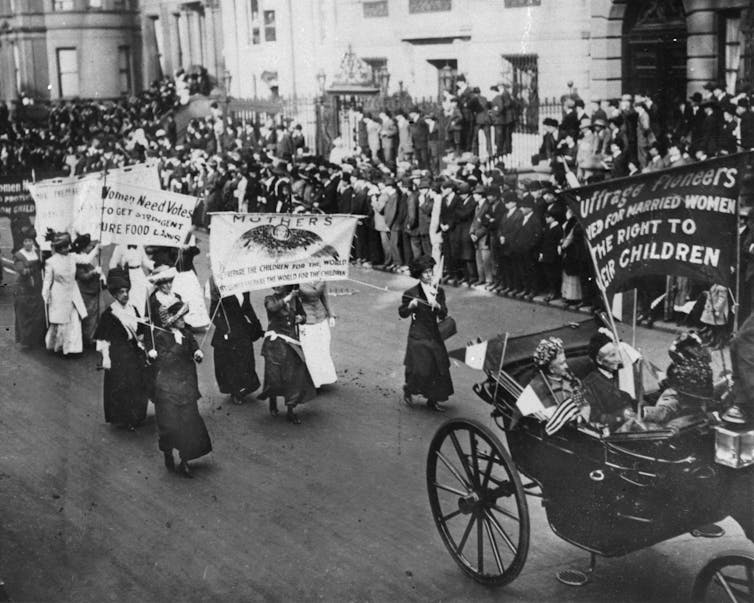
These activists were framed as threatening to not only the establishment, but also to families and the moral fabric of society.
Ironically, despite the fact that women’s entry into politics led to increased spending and improved outcomes related to women, children, families and health care, scholars have found that mother-blaming was as common after the women’s movement as it was before.
Contemporary mother-blame
Beyond political matters, contemporary mother-blame is rampant in other domains.
Mothers have been blamed for a wide variety of their children’s psychological problems, including anxiety, depression and inherited trauma. In media and literature, mothers are often blamed for criminality and violence, reflecting the notion that “mothers make monsters.”
When children struggle in school, educators and administrators may blame the mother. Mothers risk being called “too passive” if they don’t advocate for their children or “too aggressive” when they do.
Similarly, the “crazy woman” or “hysterical mother” is a well-known trope in custody law, and mothers may be blamed even when their children are abused by others. Mass shootings? Mom’s failure. The list goes on.
By setting up mothering as a high-stakes endeavour, the cultural norm of mother-blame also serves to “divide and conquer.”
In my sociology research, I found that mothers on Facebook worked to align themselves with like-minded “superior” mothers, while distancing themselves from perceived “inferior” mothers. This feeds into the cultural norm of “combative mothering,” which pits mothers against each other.

An old trick with a new spin
The “wine mom” narrative builds on this historical pattern of mother-blame. It is meant to trivialize, delegitimize, divide and denigrate mothers who are, in fact, well-organized and motivated activists concerned for their communities.
While there are legitimate concerns around maternal drinking as a coping mechanism, the “wine mom” label has begun to represent something different. Mothers are reclaiming the title to expand their cause.
As @sara_wiles, promoting the activist group @redwineblueusa stated on Instagram: “They meant to scare us back into the kitchen, but our actual response is, ‘Oh, I want to join!’”
We should acknowledge that rather than causing societal problems, mothers have a long history of trying to fix them, even if imperfectly. Mothers like Renee Good are no exception.