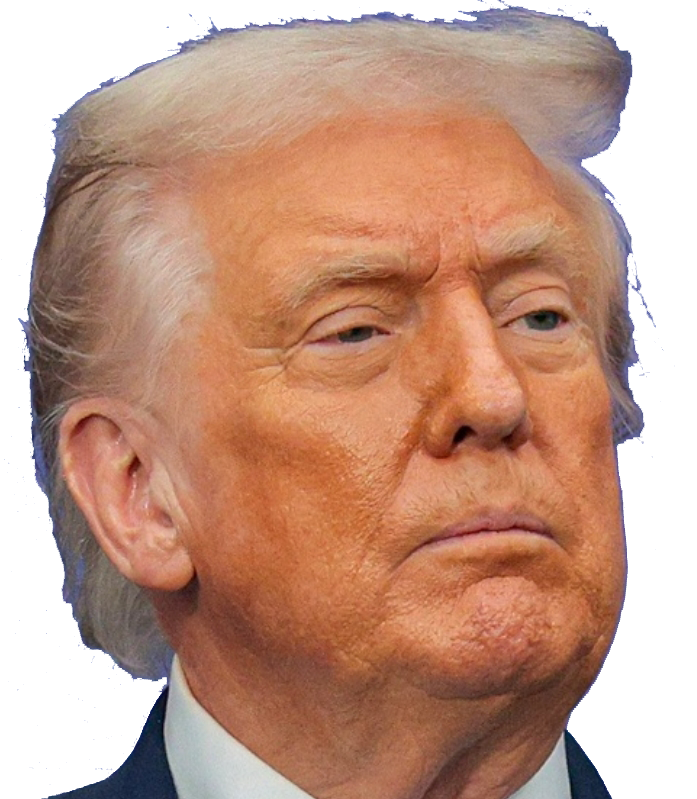
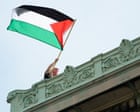

A federal judge described Donald Trump as an “authoritarian” and accused his administration of “an unconstitutional conspiracy to pick off certain people” in its aggressive pursuit of non-US citizen, pro-Palestinian activists on American college campuses.
US district judge William Young, who was appointed by the Republican president Ronald Reagan, said on Thursday that he would issue an order aimed at protecting academics who challenged the arrest and deportation of pro-Palestinian scholars such as Mahmoud Khalil and Rümeysa Öztürk.
At a hearing, Young outlined an order he will issue in a week that seeks to prevent the Trump administration from changing the immigration status of any academics in the case he is handling who are themselves noncitizens.
Any such change by the administration would be presumed to “be in retribution for their participation in this lawsuit”, the judge said. Young said he would then require the government to prove in court it was seeking to deport any such people for “appropriate” reasons.
While Young fiercely condemned the Trump administration’s attempts to deport Khalil and others, the remedies he outlined do not guarantee the administration will not attempt to target noncitizens over their speech.
“We continue to believe that Judge Young should enter relief that actually remedies the chilling effect he recognized and detailed in his earlier opinion,” said Jameel Jaffer, executive director of the Knight First Amendment Institute, which argued the case. “It’s astonishing that the Trump administration has continued to target foreign citizens based on their speech despite that opinion. It reveals a disregard and even contempt for the rule of law.”
In a blistering September ruling that sharply criticized Trump’s actions, Young had concluded the US state and homeland security departments violated the US constitution’s first amendment by chilling the free speech of noncitizen academics at universities nationally.
“The big problem in this case is that the cabinet secretaries, and ostensibly, the president of the United States, are not honoring the first amendment,” Young said on Thursday.
Noting that the case was one of “the most important” of his career, Young asked: “How did this happen? How could our own government, the highest officials in our government, seek to so infringe on the rights of people lawfully here in the United States? (Young declined an interview request by the Guardian.)
He called the administration’s abridgment of first amendment rights “appalling”, and said top officials under Trump had adopted “a fearful approach to freedom” and a “view that defines the freedom here in the United States by who’s excluded”.
“We cast around the word ‘authoritarian’,” Young said. “I don’t, in this context, treat that in a pejorative sense, and I use it carefully, but it’s fairly clear that this president believes, as an authoritarian, that when he speaks, everyone, everyone in Article II is going to toe the line absolutely.”
Article II is the part of the constitution governing the executive branch.
The White House spokesperson Anna Kelly in a statement called it “bizarre that this judge is broadcasting his intent to engage in leftwing activism against the democratically elected president of the United States”. The administration previously said it would appeal Young’s September decision.
The judge criticized the US secretary of state, Marco Rubio, and the homeland security secretary, Kristi Noem, for targeting activists and academics.
He said: “I find it breathtaking that I have been compelled on the evidence to find the conduct of such high-level officers of our government – cabinet secretaries – conspired to infringe the first amendment rights of people with such rights here in the United States. These cabinet secretaries have failed in their sworn duty to uphold the constitution.”
At one point, he compared the Trump administration’s immigration enforcement with the Fugitive Slave Act, an 1850 law that compelled law enforcement to return fugitive slaves to their “owners”, even when they were captured in free states.
Young said he would limit the reach of his forthcoming order to members of academic associations including the American Association of University Professors and the Middle East Studies Association that challenged the administration’s actions.
Those groups had sought an order blocking the administration’s practices nationally, but Young said that was “over broad”.
The lawsuit in question was filed last year after immigration authorities in March arrested recent Columbia University graduate Khalil, the first target of Trump’s effort to deport noncitizen students with pro-Palestinian or anti-Israel views.
During a two-week trial in July, both citizen and non-citizen scholars testified about the climate of fear created by the arrests, while immigration officials admitted the government relied on dossiers compiled by the rightwing Canary Mission, a secretive, pro-Israel group dedicated to doxing thousands of pro-Palestinian students, scholars and activists, as well as information by the far-right Zionist group Betar USA.
The Department of Homeland Security, in announcing Khalil’s arrest, cited executive orders Trump signed in January 2025 directing federal agencies to “vigorously” combat antisemitism after college campus protests over Israel’s war in Gaza.
Since then, the administration has canceled the visas of other students and scholars and arrested several, including Öztürk, a Tufts University student who was taken into custody in Massachusetts after cowriting an opinion piece criticizing her school’s response to the Gaza war.
Both have since been released from immigration custody at the direction of federal judges hearing challenges to their detention.
A federal appeals court on Thursday overturned the ruling in Khalil’s case, opening the door to his eventual re-detention. He plans to appeal that decision.