

In the fog-softened half light of the morning of Oct. 14, 2023, security cameras along Finland’s eastern border with Russia captured dozens of figures crossing the frontier.
After being detained, migrants told Finnish authorities they had been lured to Russia and later bused to Finland’s border by people they described as Russian border guards. By November, the number of crossings had risen to 500, prompting the Finnish government to close its border with Russia.
Weaponizing migration is just one tactic Russia is using in its expanding hybrid war — a form of conflict that seeks to undermine societies through chaos, coercion and disinformation without formally declaring war.
Over the past year, we’ve spent considerable time in the region and have been struck by a shift: leaders no longer talk about whether there will be war in the Baltics, but how to prepare for it.
This was echoed recently in a speech by NATO Secretary General Mark Rutte at the Munich Security Conference:
“I fear that too many are quietly complacent, and too many don’t feel the urgency…We must all accept that we must act to defend our way of life, now. Russia has become even more brazen, reckless, and ruthless towards NATO, and towards Ukraine.”
More than irritants
In 2024, more than 600 weather balloons and 200 drones were flown into Lithuania’s airspace from Belarus, Russia’s ally, forcing repeated temporary closures of Lithuania’s two major airports and causing millions of dollars in disruption.
In another incident two months ago, Russian fighter jets violated Estonian airspace, triggering an immediate NATO response.
Often dismissed as irritants, these actions represent an escalating challenge to the sovereignty of Lithuania, Finland, Latvia and Estonia — all NATO members. But these tactics are also co-ordinated with information warfare targeting Western European and Canadian societies.
Read more: What NATO could learn from Ukraine as it navigates Russian threats to European security
The goal is to fracture societies from within by amplifying existing social divisions to erode trust in our governments and in one another. These campaigns are also designed to encourage Canadians to question alliances with the European Union and NATO while strengthening pro-Russian political parties.
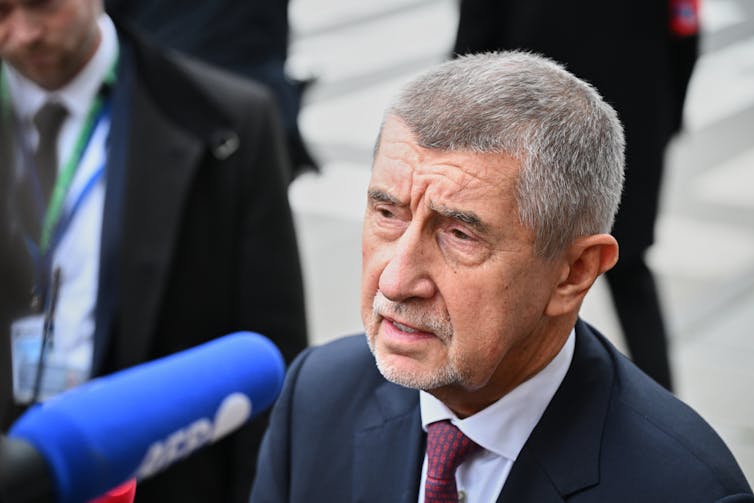
This undermines Europe’s defences and shifts political power toward Russia. This strategy has shown results, with pro-Russian parties elected this year in Georgia and the Czech Republic.
Disinformation campaigns
Russian disinformation has long sought to deny Ukraine’s right to exist as a sovereign state. In preparation for war with Europe, Russia is increasingly questioning the independence and legitimacy of Latvia, Lithuania and Estonia.
But it doesn’t stop there. Last November, Russia’s Ministry of Foreign Affairs claimed that Russia had “granted” the Netherlands its independence. Framed as historical commentary, the statement was a deliberate act of rhetorical provocation, echoing the Kremlin’s broader effort to portray democratic states as failing and their sovereignty as conditional and revocable.
Perhaps most crucially, Russia’s economy and society are being restructured to wage war. This shift cannot be easily undone, meaning that even the end of Vladimir Putin’s rule would not necessarily mean the end of Russia’s policy of expansion by war.
Canada on the front line
The war in Ukraine and the attacks on NATO partners might seem distant, but Canada is on the front lines. As part of NATO’s enhanced Forward Presence in Latvia, Canada has more than 2,000 troops deployed under Operation Reassurance.
If Baltic leaders are right, and it’s only a matter time until there’s an open war with Russia, Canadians will be on the front lines from the beginning.
Canada’s NATO commitments also mean that an attack on any of these countries will be treated as an attack on Canada.
Historically, Canada and Europe have relied on American military guarantees, but it seems highly unlikely U.S. President Donald Trump would come to the aid of Latvia and declare war on Putin. Canada and its European allies are likely on their own.
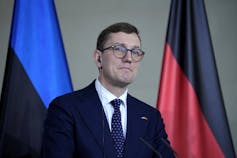
Baltic leaders are demonstrating that preparedness is not provocation but the surest path to deterrence and reassurance. We asked Estonian Prime Minister Kristen Michal what this means in practice.
He told us:
“Estonia is prepared for different threats. We know that the pressure from Russia goes beyond the military. It also includes vandalism, sabotage, airspace violations, balloons threatening aviation, cyberattacks and ongoing information campaigns — not only against Estonia, but against all allies, no matter how near or distant, including Canada.
“That’s why our approach is broad. As a NATO ally, we invest in shared defence and deterrence — five per cent of GDP starting next year. We also focus on building a strong economy and attracting investment, like the Canadian Neo Performance Materials plant in eastern Estonia. We protect our information space and work to make sure our society is resilient and ready to deal with any kind of crisis — whether it comes from aggressor states, from nature or from climate change. We are not afraid; we are prepared.”

Preparing for war
Baltic societies offer Canada a clear blueprint for countering Russian coercion, preparing for crisis and building resilience without surrendering democratic values.
We believe that the urgency declared by the NATO secretary general needs to be better understood in Canada, so it can, like its Baltic allies, prepare the Canadian economy, society and military for what is looking increasingly like an inevitability: war with Russia.
Want to write?
Write an article and join a growing community of more than 217,800 academics and researchers from 5,411 institutions.