
Middle East

The U.S.-Saudi pact covers civilian nuclear power.
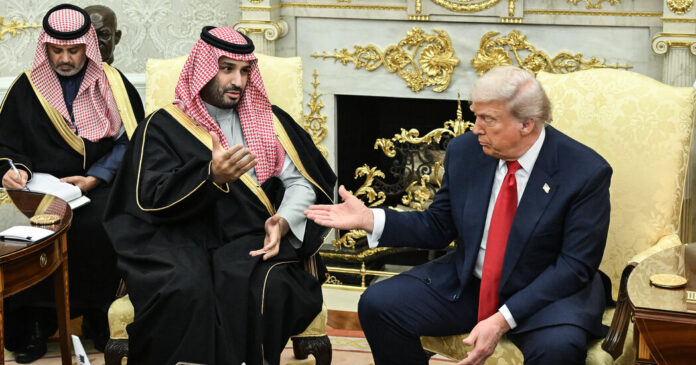
The Trump administration on Wednesday announced that it had officially signed a deal with Saudi Arabia that officials have said could help the country enrich its own fuel for nuclear reactors.
The Energy Department said that Chris Wright, the U.S. energy secretary, and Prince Abdulaziz bin Salman, the Saudi energy minister, had signed a deal to cooperate on civilian nuclear power. The two officials also signed what the administration described as a bilateral agreement on nuclear safeguards.
“Rest assured, these agreements uphold the highest standards of nuclear safety and nonproliferation, while relying on the world’s best nuclear technology and scientists, designed right here in the United States,” Mr. Wright said. “Thanks to President Trump, the American nuclear renaissance is underway and will deliver long-term benefits to the American and Saudi people.”
The agreement will require review by Congress, which has the power to vote a resolution of disapproval. But as a practical matter, the agreement would likely pass, because Congress would have to assemble a veto-proof majority to override Mr. Trump’s initiative.
The accord is intended to further bind the United States with the Saudi government as the war with Iran strains the relationship. The Trump administration, according to officials, estimates it will provide billions of dollars for the U.S. nuclear industry — starting with Westinghouse, which designs many of the reactors sold abroad.
The Saudi government has been trying to seal such an agreement for more than five years, pushing against opposition from American officials and experts who have raised concerns that the Persian Gulf nation could use the technology to pursue a nuclear weapon, spurring a new Middle East arms race.
This type of nuclear deal, known as a 123 Agreement because it’s named for Section 123 of the Atomic Energy Act of 1954, is legally binding and typically lays out rules for the transfer and storage of nuclear materials, although the president can choose to exempt countries from specific requirements.
One notable feature of the deal is that, after a joint study with Saudi Arabia on the economics of producing nuclear fuel, the Saudis may be allowed to enrich uranium or reprocess plutonium on their soil, officials have said. That’s in contrast to a 2009 agreement with the United Arab Emirates, in which the U.A.E. agreed to forgo the right to produce its own fuel.
The accord has been under discussion for years, and during the Biden administration it was envisioned as part of a broader deal that would include Saudi diplomatic recognition of Israel. But after the Oct. 7, 2023, attacks on Israel by Hamas, that prospect receded. President Trump separated the proposal for U.S.-Saudi civilian nuclear cooperation from any demand that Saudi Arabia recognize Israel.
David E. Sanger, Edward Wong, WILLIAM BROAD and Vivian Nereim contributed.


The pact allows the Saudis to skip some nuclear inspection protocols.
President Trump went to war with Iran in part to force compliance with two longstanding American demands: Tehran must stop enriching nuclear fuel for at least two decades, and it must allow international inspectors to go anywhere and see anything to verify the country is not producing a bomb.
On Wednesday, Mr. Trump took the reverse approach to Saudi Arabia, its close ally in the region. To seal a deal for Westinghouse and other American companies to seize a big piece of the business in building two nuclear reactors on Saudi territory — and more to come — it opened the door to allowing the kingdom to begin enriching its own nuclear fuel after two years.
And it gave in to the kingdom’s demand that it not have to abide by an inspection agreement that applies to more than 140 other countries. Those rules, the Saudis said, are just too intrusive.
Now Mr. Trump will have to make the case to Congress, and to allies throughout the Middle East, that in loosening the nuclear standards for one close ally, he is not ushering in a new age of proliferation, especially in a region of the world already on fire. If the daily missile exchanges with Iran finally give way to resumed negotiations, there is no question Iran will seize on the concessions made to Riyadh and insist on the same.
Already on Wednesday, administration officials were arguing that there was nothing to worry about, and that the United States will be so engaged in Saudi Arabia’s nuclear future that there is no way the kingdom could divert its nuclear fuel and know-how to a secret bomb program.
They may prove right. But nuclear history is littered with examples of countries that pledged to obey the rules, and surreptitiously raced for a bomb.
Iran’s first research reactor was provided by the United States to the shah of Iran, complete with weapons-grade uranium — technology that fell into the hands of the mullahs who took over the country in 1979. India’s first nuclear test used plutonium from a heavy-water reactor that had been a gift from the Canadian government in the 1950s. Pakistan stole its centrifuge designs from a European firm that hired A.Q. Khan, now celebrated as the father of the Pakistani bomb. Taiwan and South Korea, stalwart American allies, had secret bomb programs of their own until American intelligence agencies discovered them and quashed the efforts.
Mr. Trump has many reasons to solidify the American relationship with Saudi Arabia these days. He can argue that if the United States does not provide the country with its best reactors and nuclear technology, Russia or China will. At a time when tensions have flared with the Saudis — for a while Crown Prince Mohammed bin Salman prohibited the United States from launching attacks on Iran from U.S. bases in Saudi Arabia — anything that draws the Saudis deeper into the American technology stack makes sense to the White House.
“Rest assured, these agreements uphold the highest standards of nuclear safety and nonproliferation,” Chris Wright, the secretary of energy, said in a statement on Wednesday announcing the deal, “while relying on the world’s best nuclear technology and scientists, designed right here in the United States.”
Mr. Wright signed the deal with the Saudi minister of energy, Prince Abdulaziz bin Salman, but the White House did not immediately release the text — or the two secret letters accompanying it. All of those will now go to Capitol Hill for congressional review. But as a practical matter, Congress would have to assemble a veto-proof majority to override Mr. Trump’s initiative.
It is a process that has been used many times under the Atomic Energy Act of 1954, a key element of Dwight D. Eisenhower’s “Atoms for Peace” program. The idea was to spread nuclear energy, with safeguards to assure that fuel is not diverted to bomb projects.
But Saudi Arabia poses a particular kind of problem, hard to imagine in Eisenhower’s time. It is a country that is racing to shed its petroleum-based past and eager to embrace nuclear energy to build data centers and power a future driven by artificial intelligence, yet fearful of what might happen if the Iranians get the bomb.
Saudi officials have made no secret of their determination to keep pace with Tehran’s apparent efforts to build a nuclear weapon, and to match them if they do. In 2018, Prince Mohammed pledged that his kingdom would try to develop or acquire nuclear weapons if Iran continued its work toward a bomb — despite the fact that Saudi Arabia signed on to the Nuclear Nonproliferation Treaty in 1988, after delaying for 18 years. Other Saudi officials have issued similar warnings in recent years, or talked about the need for Saudi Arabia to become a “threshold” nuclear state, a few screwdriver turns away from building its own weapon.
“I find this decision incredibly shortsighted,” said James M. Acton, a nuclear analyst at the Carnegie Endowment for International Peace. “It appears to provide a pathway to a country that really might want to proliferate. You cannot exclude the possibility that Saudi Arabia would nationalize this facility and use it make a bomb.”
It is hardly a new problem. President George W. Bush negotiated a similar deal with the United Arab Emirates, finalized by President Barack Obama in 2009, whose terms were so restrictive that it became known as the gold standard of nuclear agreements. In return for the technology, the U.A.E. agreed to forgo producing nuclear fuel forever, and it signed the “Additional Protocol,” as the International Atomic Energy Agency calls an agreement allowing intrusive inspections. The U.A.E. now has four civilian nuclear reactors, built largely with the help of South Korea, and there is little worry that the country is interested in anything other than electricity production.
When South Korea went down the same path, the United States won a 10-year moratorium on its making its own fuel. But when President Lee Jae Myung came to Washington late last year, he got an agreement from Mr. Trump to lift the restraints. (It appears that the restrictions are still in place, at least for now.)
“It was clear Saudi Arabia was going to be different than the Emiratis,” said Robert Einhorn, a nuclear expert at the Brookings Institution who negotiated many of the toughest nuclear agreements of the past few decades as a State Department official. “They felt the inspections were just too intrusive and they weren’t going to renounce enrichment forever.”
While the Saudis agreed to a two-year study of whether it was economically feasible to produce their own nuclear fuel, they seem determined to pursue an enrichment capability, even if they had to wait awhile.
Once the terms of the Saudi deal are made public, other nations may well insist on the same treatment. The U.A.E. has a proviso in its accord that allows it to demand “consultations” with the United States if a neighboring country gets a better deal.
Heather Williams, director of the Project on Nuclear Issues at the Center for Strategic and International Studies, a Washington think tank, said the Saudi accord puts more pressure on the Trump administration to decisively eliminate Iran’s ability to build an atomic bomb.
“Preventing a Saudi nuclear weapon now means getting a concrete and hard-hitting resolution on things like inspections, what to do with the stockpile and the status of nuclear sites, including Pickaxe Mountain,” she said, referring to a complex of deep tunnels in Iran thought to harbor atomic bomb-making gear. Failure to do so, Dr. Williams added, would raise the risk of a proliferation cascade in which many nations might race for the ability to make a bomb.
The Saudi push for a nuclear accord with Washington, she added, echoes “a hedging strategy we are seeing with other allies and partners. Their neighborhoods are increasingly dangerous,” in many cases because their old guarantor of security, the United States, “isn’t as reliable as it once was.” The result is that they seek alternative deals and arrangements to bolster their security.
Dr. Williams said the Saudi accord can be seen as a victory for the United States “because it maintains U.S. partnerships in the region when China is competing for them.” The problem, she added, is that its terms are weak. “We got the partnership, but not the guardrails.”
But to those who worry that the world is on the cusp of a new nuclear breakout — what John F. Kennedy warned about just before his assassination — the Saudi deal is a step toward that danger. Kennedy was wrong when he predicted there would be more than two dozen nuclear-armed nations by the 1970s. Today, there are only nine, but it may turn out he only got the timing wrong.
“There’s no happy ending if Saudi Arabia gets within several weeks or months of making a bomb,” said Henry D. Sokolski, a nuclear policy official in the Defense Department from 1989 to 1993 who now heads the Nonproliferation Policy Education Center, a Washington-based nonprofit organization.
“Everyone worries about a proliferation chain reaction. Granting the Saudis the right to make nuclear fuel after what Iran has done is like trying to put out a fire with kerosene. It’s a sad situation. It should never have gone this far.”

Saudi Arabia’s energy ministry said in an announcement on Wednesday that the agreement with the United States would enhance their “cooperation on the peaceful uses of nuclear energy” and strengthen “bilateral cooperation in accordance with the highest international standards of nuclear safety, nuclear security and non-proliferation.” Details on what exactly the deal entails were not immediately available.
Congress must review the nuclear pact. Under the Atomic Energy Act, lawmakers have the power to vote on a resolution of disapproval. But practically speaking, the agreement is likely to pass the review; Congress would have to assemble a veto-proof majority to override it.
The Trump administration has officially signed a nuclear agreement with Saudi Arabia that officials have said could lead to the kingdom enriching its own fuel for nuclear reactors. Energy Secretary Chris Wright said this afternoon that he had signed the deal with Prince Abdulaziz bin Salman, the Saudi minister of energy.


The agreement has stoked Israeli concerns that it could lead to a regional arms race.
The announcement of a U.S. agreement with Saudi Arabia to develop a civilian nuclear program has raised Israeli concerns that it could lead to a regional arms race and underscored how the U.S. is charting its own path in the region, independent of Israel.
The agreement, signed on Wednesday, could enable Saudi Arabia to enrich its own fuel for nuclear reactors. It took many by surprise in Israel, which has a secretive nuclear weapons program, as well as a publicly acknowledged nuclear research reactor.
While Saudi Arabia has long lobbied for access to U.S. nuclear technology, the Biden administration had conditioned that in part on Riyadh agreeing to open diplomatic relations with Israel, one of Prime Minister Benjamin Netanyahu’s central goals.
Instead, President Trump is now forging a deal with Saudi Arabia that appears to sidestep Israel entirely. Analysts say it could also embolden other countries — like Turkey, which has been increasingly at odds with Israel — to develop their own nuclear enrichment programs.
Israeli opposition figures and former officials said it was the latest sign of how their country’s stature in Washington had eroded. Mr. Netanyahu lobbied Mr. Trump hard to launch a war together against Iran, which has been unpopular in the United States. Mr. Trump has called Mr. Netanyahu “crazy” for his aggressive pursuit of the related war in Lebanon against Iran’s ally, Hezbollah.
The president cut the Israeli leader out of talks with Iran to end the war that began in late February. He also persuaded Mr. Netanyahu to curb retaliation for a major Iranian attack last month, fearing it could derail peace talks.
The Trump administration is increasingly signaling that “they will move ahead, regardless of whether Israel’s red line clashes with their own,” said Avishay Ben Sasson-Gordis, an expert on U.S.-Israeli relations at the Institute for National Security Studies in Tel Aviv.
Mr. Netanyahu did not immediately comment on the U.S.-Saudi nuclear deal. At least one Israeli government minister sought to soothe public concern, arguing that the country could live with a Saudi nuclear program for civilian purposes.
“If they want it for peaceful purposes, for energy needs, we can manage it,” said Nir Barkat, Israel’s minister of economy, the most senior government official to comment on the issue so far, in a radio interview on Wednesday.
He added that normalizing ties with Saudi Arabia was “still on the table,” and that Mr. Netanyahu and Mr. Trump would not make moves that would imperil Israel.
Israel has enjoyed a de facto monopoly on nuclear weapons in the region for years, although it has never publicly admitted owning a bomb. Iran, Israel’s archrival in the region, has a nuclear program that Israel and the United States have long viewed as a grave national security threat, paving the way for the ongoing war.
Israeli opposition leaders quickly denounced the U.S.-Saudi deal as a threat. Naftali Bennett, a former prime minister, said that “enriching nuclear material on Saudi territory could prompt a nuclear race in the region, leading to a total breakdown.”
“Every military nuclear program begins with a civilian one,” said Avigdor Lieberman, a former Israeli defense minister, calling for Israel to lobby Congress to strike down the agreement.
A previous U.S. nuclear deal, with the United Arab Emirates, imposed tightened inspections and did not allow the Emiratis to enrich their own uranium, severely limiting their path to a bomb. The deal with Riyadh appears to be different, potentially allowing Saudi Arabia to enrich its own fuel, U.S. officials said.
Israeli analysts argue the Emirates might seek to revise the terms of its agreement if neighboring Saudi Arabia could enrich. Turkey, which has become one of Israel’s main regional competitors, could make a similar demand.
For Israel, much depends on whether the agreement includes safeguards that could prevent Saudi Arabia from using its nuclear capabilities for military purposes, said Michael Herzog, who served as Israel’s ambassador to Washington during the Biden administration.
“The fact that it’s not tied to normalization, nor is it clear what guardrails are in place to prevent Saudi Arabia from breaking out to a military program — both of these are sources of concern in Israel,” said Mr. Herzog, now a fellow at the Washington Institute for Near East Policy.
But Israel had little room to clash head-on with the Trump administration, its most important ally, on the issue, he added. The war the two countries started in February is still unresolved, alongside conflicts in Gaza and Lebanon.
As part of the nuclear deal envisioned by the Biden administration, the United States would have entered a formal defense treaty with Saudi Arabia. U.S. officials had also sought Israeli concessions to the Palestinians, albeit far short of an independent state, in return for normalization.
Those hopes receded after the Hamas-led attack on Israel on Oct. 7, 2023, and the subsequent war in Gaza. The political mood in Israel soured on granting any accommodations to the Palestinians, while the devastating Israeli campaign in Gaza prompted heavy criticism in Saudi Arabia.
“A nuclear deal with the U.S. was supposed to be one of the largest carrots” for Saudi Arabia to open ties with Israel, said Michael Koplow, a political analyst at the Israel Policy Forum, a research institute in New York. As Israel sees it, “now Trump has given it to them for free,” he said.
Heedo Abu Laban contributed reporting from Jerusalem.
More Administration News

Republican lawmaker urges charges against Jack Smith.
Representative Jim Jordan, chairman of the House Judiciary Committee, asked the Justice Department on Wednesday to investigate whether Jack Smith, the former special counsel, perjured himself when he testified about his inquiry of President Trump’s efforts to overturn the 2020 election.
According to a copy of the referral reviewed by The New York Times, Mr. Jordan claimed that Mr. Smith “seemingly made willfully and intentionally false statements of material fact” when questioned last December under oath about his efforts to obtain phone records of 44 lawmakers who communicated with Mr. Trump and his team.
The criminal referral could provide a catalyst for a prosecution of Mr. Smith — in many ways the top target of the president’s campaign of retribution.
“The responses provided by Mr. Smith gave the impression that neither Mr. Smith nor his team had access to the content of members’ privileged text messages,” Mr. Jordan wrote in a letter to Todd Blanche, the acting attorney general who led Mr. Trump’s criminal defense team in the two federal cases brought by Mr. Smith. “We now know this to be false.”
Mr. Smith’s legal team accused Republicans of intentionally taking his answers out of context to provide an excuse to investigate him. They say he was responding narrowly to the inquiry about the toll records, not speaking more broadly about an investigation he is precluded from publicly discussing without approval from Trump administration officials.
Mr. Smith’s lawyers, Peter Koski and Lanny Breuer, said in a letter responding to the referral, obtained by The Times, that the referral was based on a “spurious claim.”
“The referral is made not because Mr. Smith made a false statement, which the letter concedes, but because he did not proactively disclose information that was not responsive to a question asked,” they wrote.
“During his testimony, Mr. Smith provided truthful, responsive answers and candidly discussed his work,” they added. “This referral reflects a chilling eagerness to weaponize the justice system by attacking a career, nonpartisan public servant who faithfully and fearlessly performed his duties by following the facts and the law.”
Mr. Smith has long said he expected to be prosecuted. Many of Mr. Trump’s Republican allies in Congress have been wary of going after Mr. Smith, whom they see as a credible and dangerous adversary itching for an opportunity to publicly revisit evidence that Mr. Trump tried to overturn a free and fair election.
Criminal referrals are recommendations without the force of law and do not necessarily lead to prosecutions or even investigations. But it will almost certainly attract Mr. Trump’s notice and increase the pressure inside the department to go after someone the president has identified as the man who led a politically motivated attack on himself and his supporters.
The referral was prompted by recent disclosures to Senate Republicans that Mr. Smith’s team obtained messages from lawmakers who communicated with White House officials after Mr. Trump’s defeat in 2020. It was part of his effort to uncover evidence Mr. Trump coordinated a conspiracy to subvert the election results.
In the exchange cited in Mr. Jordan’s letter, Mr. Smith was asked about his request for toll records — metadata of calls and texts without the content of communications — from members of Congress. Such requests are common in complex criminal investigations to establish timelines and provide proof of communication.
“Did the toll records that you requested from the senators, did they include the content of the phone calls?” a Republican committee staff member asked Mr. Smith.
“No,” he replied.
Senator Josh Hawley, a Missouri Republican whose toll records and text messages were obtained by the special counsel, suggested during a committee hearing last week that Mr. Smith had perjured himself.
“What really gets me at the end of the day is he lies about it,” he said. “I mean, he has lied and lied about it.”
Representative Jamie Raskin of Maryland, the top Democrat on the Judiciary Committee, said Republicans “embarrassed themselves” by failing to ask Mr. Smith a broader question about all requests by his team for phone records.
“When asked if his subpoena for members’ toll records sought the content” of their phone calls or messages, Mr. Raskin said, “he truthfully replied that they did not.” He added: “That statement was true when he said it, and it is true today.”
Last week, the Justice Department handed over to Senator Charles E. Grassley, Republican of Iowa, records showing that Mr. Smith’s team obtained the phones of White House officials and close Trump allies from the National Archives dating from October 2020 through Jan. 20, 2021.
The batch included private communications with 40 congressional Republicans, among them Mr. Grassley and several other member of the committee, including Senator Lindsey Graham of South Carolina and Mr. Hawley, who has repeatedly demanded the department investigate Mr. Smith.
The records also included messages from four Democrats — Senator Cory Booker of New Jersey and three members of the House, Representatives Adam Smith of Washington, Josh Gottheimer of New Jersey and Karen Bass of California, who is now the mayor of Los Angeles.
Mr. Grassley accused Mr. Smith of violating the Constitution’s speech and debate clause, which prohibits the executive branch from encroaching on the rights of the legislative branch, in a statement calling his investigation “a runaway train that had no brakes.”
The lawmakers were not the targets of the records request, however. Their messages were found on the phones of many of those at the center of the investigation into the Trump team’s efforts to overturn President Biden’s victory, including the former White House chief of staff Mark Meadows, Ivanka Trump, and allies and aides including Stephen Miller, Peter Navarro, Kash Patel, Rudolph W. Giuliani, and Kellyanne Conway.
Michael Gold contributed reporting.


Trump’s plan for science: more money for A.I. and less for universities.
President Trump’s science adviser told lawmakers on Wednesday that the Trump administration intended to drastically overhaul the country’s approach to scientific research, including by shifting research funding away from universities toward individual researchers and private companies.
At a House hearing, Michael Kratsios echoed points he laid out in a report released Tuesday, titled “Science: A New Golden Age.” He said the administration would prioritize artificial intelligence, robotics and nuclear energy while reducing the government’s focus on what he called “life sciences.”
“Our ability to make transformational breakthroughs here in the United States has slowed,” Mr. Kratsios told lawmakers in the hearing on Wednesday. “Maybe we should be testing other ways to make breakthroughs than what we’ve been doing for so many years.”
Democrats countered that the Trump administration had harmed scientific research by firing staff members at federal science agencies, seeking deep cuts to research programs, canceling or freezing grants, punishing universities that Mr. Trump is unhappy with, and pushing some of the best researchers in the United States to relocate to other countries.
“Let me propose an alternative title: ‘Unleashing the Golden Age of Science in the People’s Republic of China,’” Representative Zoe Lofgren of California, the top Democrat on the House science committee, told Mr. Kratsios at the start of the hearing. “This administration has been systematically destroying the U.S. science enterprise.”
The White House billed Tuesday’s report as “the first comprehensive rethinking of the U.S. science and technology enterprise in over 80 years,” since one written by Vannevar Bush, the organizer of the Manhattan Project, which produced the world’s first atomic bomb. Dr. Bush’s 1945 report set the stage for the current system, in which the government funds basic research, universities conduct it, and private companies commercialize it.
Mr. Kratsios’ proposal to reduce the role of universities would upend that system, which has been in place since the end of World War II. His call for the administration to de-prioritize “life sciences,” which encompass molecular biology, genetics and other fields in biomedicine, as well as clinical trials aimed at testing new therapies, raised alarms among biomedical researchers and academic medical centers. They fear it will mean less funding for the National Institutes of Health.
Jeremy M. Berg, who led the National Institute of General Medical Sciences, an arm of N.I.H., during the Bush and Obama administrations, called the report “tremendously misinformed.” He said Mr. Kratsios was ignoring the serendipity of science by zeroing in so closely on artificial intelligence.
“I think they’re trying to turn it into a venture capital model,” said Dr. Berg, an expert in computational and systems biology medicine at the University of Pittsburgh. “Why the federal government should be investing in that, I don’t know.”
Unlike most presidential science advisers, Mr. Kratsios is not a scientist. He has a background in Silicon Valley, where he worked at an investment fund run by Peter Thiel, the prominent venture capitalist who backed Mr. Trump’s first presidential bid. Mr. Kratsios’ educational background is also unlike that of his predecessors: While previous science advisers held doctorates, Mr. Kratsios has a bachelor’s degree in politics from Princeton, and no other degrees.
The report from Mr. Kratsios, who also leads the White House Office of Science and Technology Policy, begins with a broad indictment of the federal government’s approach to funding scientific research.
Mr. Kratsios argued that while investments in research had increased in recent decades, the results of that investment had failed to keep pace. “Scientific productivity has slowed,” he wrote. Among the examples he cites: “Despite massive increases in biomedical funding since the 1990s, the rate of significant breakthroughs appears to have slowed, and drug approvals have flatlined.”
To address that problem, Mr. Kratsios called for reducing the amount of time researchers have to spend applying for grants, and directing science agencies to come up with ways to better measure the returns on their investments.
He also directed federal science agencies to focus on a handful of priorities set by the White House, including physical sciences, chemistry and biological sciences.
Those fields, he wrote, were crucial to what he called the Trump administration’s “national missions” — a list that includes artificial intelligence, nuclear fusion, robotics, quantum computing and space exploration.
The report is less clear on the areas of scientific research for which the federal government should reduce funding. It says federal agencies “should prioritize foundational research in the biological sciences over the life sciences.”
Spokesmen for the White House and the Department of Health and Human Services did not answer questions about what they meant by “life sciences” and “foundational research.”
Health Secretary Robert F. Kennedy Jr., who oversees the U.S. biomedical research enterprise, said the report aligned with his own emphasis on using artificial intelligence to uncover the root causes of what he calls an “epidemic” of chronic disease, especially among children.
“America will lead the next generation of medical discovery by harnessing the power of artificial intelligence,” he said in a statement.
The report does not address the Trump administration’s decision to fire large numbers of staff members at scientific agencies. It calls for the government to invest in young researchers, without noting that the administration fired scores of young scientists and terminated hundreds of grants to early career researchers.
It is also silent on the more than 40 percent funding cuts sought by the White House at the National Science Foundation, as well as a proposal in May from the White House Office of Management and Budget that federal grants for scientific research be screened by political appointees, to block initiatives that “promote anti-American values.”
In Wednesday’s hearing, Democrats pushed Mr. Kratsios on those points, asking how they aligned with his pledge to restore what he called “gold standard science.”
Letting political appointees block grants they disagree with is “simply incompatible with any kind of commitment to robust scientific research,” Representative Deborah Ross of North Carolina said to Mr. Kratsios. “The victories that you’re touting are merely cheap, shiny distractions.”
In response, Mr. Kratsios did not directly defend the administration’s proposal for political oversight grants. “I look forward to working closely with O.M.B. to ensure that our enterprise continues to remain world class and trustworthy and accountable,” he said.
One area in which Mr. Kratsios indicated a measure of disagreement with the administration’s actions was on the pace of grants from the National Science Foundation.
Representative George Whitesides, Democrat of California, displayed charts comparing the rate at which money had been awarded this year with previous years, asking Mr. Kratsios to explain why the funding had slowed. When Mr. Kratsios said that was a question for the National Science Foundation, Mr. Whitesides called the answer unacceptable.
“You’re the president’s science adviser,” Mr. Whitesides said. “Why is this happening?”
“I do see these charts, and nothing would make me happier to make sure that we are getting closer to where we were in previous years,” Mr. Kratsios said. “I’ll do everything that I possibly can to help move that line, because I think it’s important for us to get the appropriate dollars out to scientists.”
Adam Sella and William J. Broad contributed reporting.

The House adopts a $95 billion G.O.P. budget for the war with Iran.
House Republicans on Wednesday won narrow approval of their $95 billion budget plan to fund the war with Iran and impose new election restrictions President Trump has demanded, muscling through dissent in their ranks to send the measure to a skeptical Senate.
The blueprint would pave the way for filibuster-proof legislation known as a reconciliation bill that would bypass Democratic opposition and provide up to $73 billion in additional military funding, $12 billion for farmers and $10 billion to enforce severe new voting restrictions championed by Mr. Trump.
It was approved in a 216-to-214 vote, with all but two Republicans in favor despite considerable concern in their ranks about its cost, its scope and voting to fund an unpopular war just months before the midterm elections.
The plan faces an uphill fight in the Senate, where the Republican leader has cast doubt on his chamber’s willingness to embrace it.
The debate featured little in the way of direct discussion about the war with Iran, for which the bulk of the money is intended.
Speaking at length on the House floor in support of the plan, Representative Jodey Arrington, Republican of Texas and the chairman of the Budget Committee, described the effort as “supporting our troops in their time of need.”
“Just base-line battlefield readiness,” Mr. Arrington said. “Bullets and bombs to finish the job, and to come home safely and victoriously.”
Representative Mike Rogers of Alabama, the chairman of the Armed Services Committee, also omitted any mention of Iran, though he alluded to the conflict.
“No matter how you feel about the current events, these funds are necessary to ensure our fighting forces remain ready, our troops are paid and our nation is safe,” he said.
In the days leading up to the House vote, various Republican factions had quietly voiced grievances about the resolution. Budget hawks objected to the fact that none of the new spending would be offset by new cuts. Defense hawks said their party should use reconciliation to provide even more money to the Pentagon. Center-leaning House Republicans facing competitive re-election races were skittish about voting to fund a war that has driven costs up.
But as with most legislative initiatives that Mr. Trump demands, there was a sense of inevitability in the House about adopting the blueprint, and in the end, most would-be defectors swallowed their objections and fell in line.
In the end, only two Republicans, Representatives Thomas Massie of Kentucky and Warren Davidson of Ohio, and one independent who aligns with the G.O.P., Representative Kevin Kiley of California, voted no.
Fiscal hard-liners said they were willing to add $95 billion in spending in exchange for a promise that the reconciliation measure would eventually include new voting restrictions that would require people to prove they are citizens when they register to vote, impose strict new identification requirements for voting and severely curb voting by mail.
The blueprint hews closely to an emergency spending request the White House sent Congress in June to provide more money primarily for the Pentagon. Republicans have sought to fund it through reconciliation, legislation that is not subject to a filibuster because nearly all Democrats have said they are opposed to the war and will not vote to allocate money for it. In the Senate, spending bills typically need bipartisan support — 60 votes — to advance.
Representative Hakeem Jeffries of New York, the Democratic leader, called the legislation an “America Last Republican budget that will provide billions of additional dollars to Operation Epic Fury in the Middle East, which has been a complete and total disaster for the American people.”
It would be the third time in 18 months that the party has turned to reconciliation — a maneuver created to make it easier to pass bills that reduce federal deficits — to push through major elements of their agenda.
Yet it was far from clear that the budget blueprint would gain traction in the Senate.
Senator John Thune, Republican of South Dakota and the majority leader, suggested at a news conference on Tuesday that the Senate would “hold” the House’s budget resolution — not acting on it immediately but keeping it available — until he was sure the Senate could move a stopgap funding bill to avert a government shutdown at the end of September.
“It’s a possibility that, if necessary, we could pull that budget resolution passed by the House and use it to fund the government,” Mr. Thune said.
Even before that, a number of Republicans in the Senate had questioned the plan’s viability. Senator Roger Wicker of Mississippi, the chairman of the Armed Services Committee, has said he opposes it because it does not provide the Pentagon with enough money. Mr. Wicker has said he wants to ensure the military receives the full $1.5 trillion in funding Mr. Trump included in his budget request.
Senators Lisa Murkowski of Alaska and Thom Tillis of North Carolina both oppose the inclusion of the voting restrictions, known as the SAVE Act. Many Republican senators doubt that the measure will be allowed to remain in the reconciliation bill, which is subject to strict rules requiring that all provisions make direct changes to spending or revenue.
And Ms. Murkowski signaled she was wary that the Trump administration might interpret a vote in support of supplemental war funding as a vote by Congress authorizing the conflict with Iran. The president has not sought such authorization, and lawmakers in both parties have voted to require it.
In a hearing on Tuesday before the Appropriations Committee, Ms. Murkowski asked Defense Secretary Pete Hegseth whether he believed that a vote on “funding alone can substitute for explicit congressional authorization.”
Mr. Hegseth said he would defer to his legal team.

Robert Jimison, who covers foreign policy and defense issues in Congress, reported from the Capitol.
The House passes a defense bill amid divisions over the Iran war.
A divided House on Wednesday approved a $1.15 trillion defense policy bill as Republicans pressed ahead with a historic increase in military spending over the opposition of Democrats who voted against the plan in protest of the war in Iran.
Passage marked a victory for Republicans seeking to reshape the Department of Defense in line with President Trump’s aims, but the near party-line vote on what is normally a broadly bipartisan bill reflected major obstacles that could complicate its path to enactment.
In a 216-212 vote, all but a half-dozen Democrats opposed the measure, many saying that they could not in good conscience back a bill that ultimately would empower Mr. Trump to continue waging war against Iran without authorization or meaningful oversight by Congress.
Senate Democrats blocked that chamber’s version last week for the same reason, and G.O.P. leaders in the Senate lack the votes to overcome their opposition.
It sets up a clash over the annual defense policy bill, known as the National Defense Authorization Act or N.D.A.A., that will likely to require significant bipartisan revisions if Congress hopes to send the legislation to Mr. Trump before the end of the year.
The bill includes a pay raise for service members, increased funding for missile defense production and additional resources to boost strategic investments in critical minerals. The sprawling legislation also contains a range of provisions directly related to how the U.S. military integrates and regulates artificial intelligence across the department.
It also would officially rename the Department of Defense the Department of War, part of an effort by him and Defense Secretary Pete Hegseth to rebrand the military in a way they argue better projects American strength and reflects the department’s core mission.
Republicans lauded the bill’s passage as another step to shore up Mr. Trump’s legislative agenda. Speaker Mike Johnson noted that the bill codifies “over 65 of the Trump administration’s executive orders and legislative proposals.”
The bill, which was supported by all but seven Republicans, would deliver the largest annual jump in military spending in modern history. It increases the national defense budget by more than $227 billion over the previous year, a boost Republicans say is needed to prepare the United States for a more dangerous world.
“For the first time in 40 years, we’ve been presented a budget that accounts for the true cost of American deterrence,” Representative Mike Rogers of Alabama, the chairman of the Armed Services Committee and the bill’s chief author, said.
He said that because of “decades of underinvestment in the U.S. military,” the United States no longer has the capacity to produce military equipment fast enough for a prolonged war, pointing to a shrinking defense industry and dwindling stockpiles of weapons.
Representative Adam Smith of Washington, the top Democrat on the Armed Services Committee who joined his party in opposing the measure, argued that Republicans had transformed a bipartisan bill into a divisive one.
“Whatever else may be said about the N.D.A.A. — there’s a lot of positive aspects to it — it will continue to support the Department of Defense the president is using to wage this war,” Mr. Smith said. “And that makes it very difficult to support this.”
The debate came as Republicans had hoped the war in Iran was entering its final chapter. Lawmakers had seen the signing of a memorandum of understanding and announced cease-fire last month as the pivot point necessary to allow them to spend their last days before a five-week summer recess highlighting domestic accomplishments and begin focusing on the midterm elections. Instead, the conflict has reasserted itself just as lawmakers prepare to leave Washington to campaign for re-election.
Mr. Smith said Republicans had blocked Democratic amendments and reshaped the legislation around the administration’s push to supercharge military spending at the expense of domestic programs that Americans depend on.
He argued that the administration’s broader goal of pushing military spending to above $1.5 trillion through three measures making their way through Congress — the defense bill, an emergency supplemental spending measure it has requested to pay for the war in Iran and a forthcoming reconciliation package that would include much of that money — was fiscally unsustainable.
“We’re making cuts to Medicaid and other health care programs in order to fund this,” he said. “The math just doesn’t add up.”
Mr. Smith faulted Republicans for continuing to fund an expanding war in Iran while declining to reassert Congress’s constitutional role in authorizing and overseeing the conflict, saying lawmakers were being asked to provide ever larger sums for military operations without meaningful debate over the strategy or its objectives.
Representatives Jared Golden of Maine, Marie Gluesenkamp Perez of Washington, Adam Gray of California, Don Davis of North Carolina, Vicente Gonzalez and Henry Cuellar, both of Texas, were the only Democrats to break with their party to support the measure.
Representatives Anna Paulina Luna of Florida, Chip Roy of Texas, Thomas Massie of Kentucky, Eli Crane of Arizona, Harriet Hageman of Wyoming, Tim Burchett of Tennessee and Josh Brecheen of Oklahoma all broke with fellow Republicans by voting against the bill.
The House measure is one piece of a broader effort by the Trump administration to bring military funding to unprecedented levels that proponents argue is necessary to rapidly expand the armed forces as the United States confronts simultaneous threats from China, Russia, Iran and other adversaries.
Appearing before the Senate Appropriations Committee this week, Mr. Hegseth described the strategy as a “generational investment” in the military, calling the emergency funding request an “urgent, necessary injection” amid a war that he said had so far cost $37.5 billion.
“Without these funds, we face critical shortfalls,” Mr. Hegseth testified.
In recent days, Mr. Trump has abandoned the more optimistic tone that a diplomatic resolution could be met to draw the war to a close and has instead issued increasingly forceful warnings to Iran’s leadership.
On Wednesday, Mr. Trump warned that Iranian strikes against vessels navigating through the Strait of Hormuz would be responded to with attacks on key infrastructure.
“From this point forward, any time the Islamic Republic of Iran shoots at a ship in the Strait of Hormuz, whether it be by Missile, Rocket, Drone, or any other device or weapon, the United States will bomb and destroy ONE BRIDGE OR POWER PLANT, including those located next to, or in, the Capital City of Tehran,” he wrote in a post to his social media site.
Moments later, as he was preparing to depart for the dignified transfer of four American service members killed in the conflict, Mr. Trump previewed more strikes telling reporters that Iran was “going to pay a big price.”
“They’re getting decimated,” he added.
President Trump’s assertion that the war in Iran is simply a “skirmish” comes days after the Pentagon identified the three latest U.S. casualties and a fourth soldier who is “believed to have been killed in action.”
There have been 18 American military personnel confirmed killed since the war in Iran began in February with a U.S.-Israeli assault. More than 1,700 Iranian civilians have been killed, according to estimates.

“They’re getting hit so hard and they want to make a deal,” President Trump says, as he describes the war in Iran as a “skirmish.” His comments come as reports show that nearly a dozen U.S. troops serving in the Middle East were wounded severely enough by Iranian missile and drone attacks in Jordan and other countries this month that they were flown to a U.S. military hospital in Germany for treatment.
The Defense Department did not disclose the latest rash of casualties in Jordan and elsewhere in the Middle East until The New York Times reported on injuries from four attacks last week.

President Trump told a crowd in Georgia that after attending the dignified transfer at Dover Air Force Base today to honor four U.S. service members killed in the Iran war, he offered the family of one of the fallen a ride on Air Force One back to Georgia.
The family, Trump recalled, said, “‘Wow this is something, thank you so much.’” He added: “But they’re heartbroken.”

Treasury Secretary Scott Bessent threatened to impose sanctions on Chinese firms that steal American artificial intelligence technology. “We support open-source AI and the innovation it unlocks,” Bessent wrote in a post on X on Wednesday. “But open source is not open season on American IP.” U.S. A.I. companies have accused Chinese firms of using American models to build their own.
We are about 10 minutes into President Trump’s event in Georgia that was billed as a speech on Trump accounts but that so far has resembled a campaign rally. Trump had been celebrating what he described as the accomplishments of his policies before turning to Iran.
He said the United States did not need the Strait of Hormuz “but we do it because we have to do it, because we cannot let Iran have a nuclear weapon.” Iran’s closing of the Strait of Hormuz in recent weeks has, however, sent economic shockwaves across the world and periodically caused energy and gas prices to surge.


A judge strips protections for an endangered lizard at the administration’s request.
At the request of the Trump administration, a federal judge in Texas has stripped endangered species protections from a small lizard whose habitat overlaps with the largest oil-producing region in the United States.
It was the latest twist in a long-running fight over the fate of the dunes sagebrush lizard, a light brown reptile found only in portions of the oil-rich Permian Basin in southeastern New Mexico and West Texas.
The Biden administration classified the lizard as endangered in 2024, saying it faced grave threats from oil and gas development and climate change. But the state of Texas sued, and the Trump administration asked the judge to remove the lizard from the endangered species list as part of a settlement with the state.
The judge, David Counts of the U.S. District Court for the Western District of Texas, approved the settlement on Tuesday. Judge Counts, who was appointed by President Trump, found that the Biden administration’s evaluation of the lizard’s habitat was “potentially inaccurate.”
It was the second time in a year that Judge Counts allowed the Trump administration to remove an animal from the endangered species list in response to a lawsuit brought by industry or states. In the previous case, Judge Counts agreed to rescind protections for the lesser prairie chicken, another species whose habitat puts it in conflict with the oil and gas industry.
And the administration has moved to do the same in a third case, this one involving seven species of freshwater mussels found in rivers and creeks in Central Texas. In all three instances, the Trump administration has argued that Biden-era findings in favor of safeguarding the species were made in error or with incomplete information.
Conservationists defended the science behind the original findings and said they saw a troubling pattern, especially given that all three cases involve species that reside in or near the Permian Basin.
“Sound science is being thrown under the bus for politics,” said Jason Rylander, a legal director at the Center for Biological Diversity, a conservation group that tried to intervene in the cases but was denied the opportunity.
Mr. Rylander said that in 25 years of practicing conservation law, he had never before seen an administration use the courts to hastily strip protections from a species. He said the government would typically conduct a new scientific review and solicit public comments before altering a decision that had taken years to complete.
That review would now happen after the species has lost protections. The settlement notes that the U.S. Fish and Wildlife Service “anticipates” a new initial finding for the lizard within 24 months.
Representatives for the Interior Department, the parent agency of the Fish and Wildlife Service, did not respond to requests for comment.
Mr. Trump campaigned on an agenda of “drill, baby, drill,” and his administration has moved to weaken or remove protections for species that stand in the way. In March, for example, a powerful federal panel nicknamed the “God Squad” convened for the first time in three decades, voting to exempt oil and gas drilling in the Gulf of Mexico from measures to protect endangered whales and other imperiled species.
Less than three inches long, the dunes sagebrush lizard lives in sand dunes and among shrubs called shinnery oaks, which provide food, shade and breeding grounds. In 2007, the leading global scientific authority on the status of species, the International Union for Conservation of Nature’s Red List, classified the lizard as vulnerable, meaning it faces a high risk of extinction in the wild.
When the Fish and Wildlife Service listed the lizard as endangered in 2024, it found that activities associated with oil and gas drilling, including road construction and well pad clearing, could damage or destroy the duneland ecosystem. The agency also cited threats from hotter and drier conditions driven by climate change.
But Texas Attorney General Ken Paxton sued over the decision, saying the Fish and Wildlife Service failed to use the best scientific and commercial data available. In a statement at the time, he also accused the Biden administration of a “backdoor attempt to undermine Texas’s oil and gas industries.”
Representatives for Mr. Paxton, who recently won a Republican primary runoff for a U.S. Senate seat after receiving an endorsement from Mr. Trump, did not respond to a request for comment.
Two Republican members of Congress, August Pfluger of Texas and Tracey Mann of Kansas, introduced legislation last year to remove the dunes sagebrush lizard from the endangered species list and to prohibit its listing in the future. But the bill, the Limiting Incredulous Zealots Against Restricting Drilling (LIZARD) Act, faces an uncertain path.

House Republicans have tied their entire legislative agenda to Trump’s SAVE America Act.
Strictly speaking, the House of Representatives is not voting this week on President Trump’s long-demanded federal elections overhaul that would impose nationwide voter identification and proof of citizenship requirements and limit voting by mail.
Lawmakers are scheduled instead to vote on Wednesday on the annual defense policy bill, which authorizes more than $1 trillion in military spending; a $95 billion budget plan to pay for the war in Iran; and legislation that would impose restrictions on stock trading by lawmakers.
But Republicans have tied all three of those measures to pieces of the SAVE America Act, the elections bill Mr. Trump has called his top priority. The tactic is aimed at forcing action in the Senate, where the bill is stalled amid bipartisan opposition.
The moves are the latest sign that the G.O.P. has subjugated its entire legislative agenda, months before midterm elections in which its congressional majorities are in peril, to the president’s obsession with cracking down on election fraud that he claims, despite evidence to the contrary, is rampant.
Under a complex maneuver the G.O.P. engineered on Tuesday, if the defense bill passes, it will be merged with major pieces of the voting restriction legislation, which the House passed in February, before being sent to the Senate. The budget plan includes $10 billion that could be used for enforcing new voting requirements, which is aimed at allowing Republicans to try to include the SAVE Act in a party-line, filibuster-proof budget measure they want to push through Congress. And the stock trading bill includes an unrelated provision requiring photo identification when casting a ballot in person or by mail.
The convergence of the SAVE America Act with unrelated measures springs from Speaker Mike Johnson’s efforts to placate Mr. Trump and far-right House Republicans who are furious that the voting restriction bill has run aground in the Senate. The moves are unlikely to budge Senate Republicans; they consider the bill dead, given that it cannot draw the 60 votes needed to move forward in that chamber.
But Mr. Johnson had to try. Republican hard-liners had blockaded the House floor over the matter, refusing to move on any legislation until the SAVE Act advanced.
So he agreed to use an arcane procedural tactic that appends a version of the SAVE America Act to all major bills the House considers before sending them to the Senate. The appended version does not include Mr. Trump’s desired restrictions on voting by mail, which are opposed by a significant number of Republicans.
If the defense bill passes, attached provisions would require Americans to show documentary proof of citizenship to register to vote and to show specific forms of photo identification at the polls. The House also attached those measures last week to a bill that funds the State Department and foreign aid programs.
These moves are largely symbolic. The Senate has its own versions of the defense policy bill and the foreign affairs spending measure and is not expected to adopt the House’s bills.
The budget plan, the first step in a special legislative process known as reconciliation that would allow senators to bypass the filibuster and Democratic opposition, includes $10 billion for the House Administration Committee. That panel handles federal elections legislation, and the money would go toward making changes in laws under its jurisdiction.
But it is not clear whether that measure has sufficient support in the Senate, where many Republicans are skeptical of the effort. And it is equally unclear whether reconciliation can be used for pieces of the elections bill, since the process has strict rules requiring that all provisions make direct changes to spending or revenue.
Republicans also added voting measures to the stock trading bill, which would bar members of Congress from buying individual stocks but allow them to keep and sell existing ones. The added measures would require Americans to show certain forms of photo ID in order to vote, including if they were voting by mail.
Democrats are solidly opposed to the elections legislation, which they argue would suppress voting by making it more difficult for eligible voters to gain access to the polls.
Though many Democrats back the stock-trading limits for lawmakers, most are expected to oppose the bill on Wednesday, on the ground that the voter identification restrictions Republicans inserted have made the measure unacceptable.

Ana Swanson covers international trade and reported from Washington.
The U.S. trade representative, Jamieson Greer, calls Trump’s tariff policy a success.
Jamieson Greer, the U.S. trade representative, told Congress on Wednesday that a “national emergency” on trade persisted and that the administration remained intent on using tariffs to transform the economy.
Testifying before the Senate Finance Committee on Wednesday, Mr. Greer said he considered President Trump’s tariff policy a success and would use whatever tools he had available to continue it.
The Trump administration is preparing to introduce another barrage of global tariffs as soon as this week, as the president tries to replace tariffs that were declared legally invalid in February.
“The specific authorities this administration is using have changed, but the trade strategy has not,” Mr. Greer said. “We are committed to continuing to use tariffs and to negotiate deals to support the reindustrialization of our economy, protect American workers and increase their wages and shrink our trade deficit.”
At the hearing, several Republican senators emphasized the importance to their states of maintaining and expanding trade ties. Democrats denounced the Trump administration for treating close allies like Canada so harshly, including with newly threatened tariffs this week.
Democrats also criticized tariffs for adding to the prices of consumer goods for American families, something Mr. Greer tried to rebuff.
“These tariffs are raising costs, and everybody seems to know that except the Trump administration,” said Senator Raphael Warnock, Democrat of Georgia.
The Trump administration has been working to repair its global tariffs after the Supreme Court in February ruled that Mr. Trump’s use of an international emergency to issue global tariffs last year was unlawful. That decision struck down tariffs Mr. Trump had announced last year on what he called “Liberation Day,” and cast into question the trade deals the administration had negotiated based on those levies.
As a stopgap measure, Mr. Trump used another legal measure to impose a flat 10 percent tariff globally. That tariff is set to expire on Friday, but the administration has already readied a replacement.
In June, the Office of the United States Trade Representative proposed imposing a tariff of between 10 and 12.5 percent on goods from more than 80 countries, using a legal authority known as Section 301. It argued that those countries’ failure to impose and enforce laws blocking goods made with forced labor from their markets had unfairly disadvantaged the United States.
It’s not clear when those tariffs will be imposed, but several people familiar with the plans said they anticipated them to be ready before the current 10 percent base line duty expires on Friday. The Trump administration is also preparing another tranche of tariffs under Section 301 that relates to other countries’ practices toward their factory sectors, and they could be put into effect in the coming weeks or months.
The administration has continued to double down on other tariffs as well. Mr. Trump on Monday signed orders to impose a 50 percent tariff on a wide range of Canadian goods, claiming that Canada had discriminated against the United States in key industries. He said on Tuesday that the United States would impose steep tariffs on generic medications in 2028.
Some analysts speculated that Mr. Trump was trying to force Canada to the negotiating table in talks over the United States-Mexico-Canada Agreement. U.S. and Mexican officials are discussing that deal in Mexico City this week, but talks between the United States and Canada have not officially begun.
Canada and Mexico are the United States’ biggest export markets, and particularly crucial for U.S. agriculture. At the hearing, both Republicans and Democrats reiterated the importance of the U.S.M.C.A. deal to their states.
Senator Ron Wyden, the top Democratic on the Finance Committee, criticized the administration for placing 50 percent tariffs on some Canadian products while rolling “out the red carpet” for China, “one of the biggest trade cheats there is.”
“It just seems to me that on tariffs, the administration has lost the plot,” he said.
Senator Peter Welch, Democrat of Vermont, said that the tariffs, whatever their intent, were “really causing a lot of harm so far in Vermont, both the tariffs and the way in which they are variable and changing quite a bit.” Canada is Vermont’s top trade customer, he added.
Mr. Greer responded that Canada had benefited from the best trade treatment, even under Mr. Trump’s trade policy since last April.
“We’re trying to balance this relationship, have as much trade, liberal trade in North America as possible while protecting our producers,” Mr. Greer said. “It’s not going to happen overnight,” he said.
Mr. Greer said that there were aspects of the U.S.M.C.A. that needed to be changed, such as adding rules that would require more auto production in the United States. But he said that the deal included certain “load-bearing pillars,” provisions that ensured agricultural market access and other areas where the United States hadn’t seen problems.
“But where we have seen issues, we’re already in process of fixing it to make sure we can get more production here in the U.S.,” he said.
Lawmakers are weighing whether to expand or restrict the president’s ability to impose tariffs. While the Constitution gives power over trade to Congress, lawmakers have written numerous laws that allow the president to issue tariffs in certain circumstances.
Mr. Wyden introduced a bill on Wednesday that would eliminate or reform various tariff authorities delegated to the president to reassert Congress’ authority over such duties. The bill would mandate Congressional approval for tariffs, establish a committee that would review the president’s tariff actions and make clear that binding trade pacts need approval from Congress.
But Congress is also considering a bill, sponsored by the late Senator Lindsey Graham, that would allow the president to increase tariffs up to 100 percent on countries that buy the largest quantities of Russian oil and natural gas. Some have warned that the bill could give Mr. Trump an even more flexible tool to impose tariffs on China, India, the European Union, Japan and others.
Advertisement