
President Trump claimed over the long weekend that he was on the brink of a peace deal with Iran but offered few details. The United States then carried out new strikes against the country on Monday.
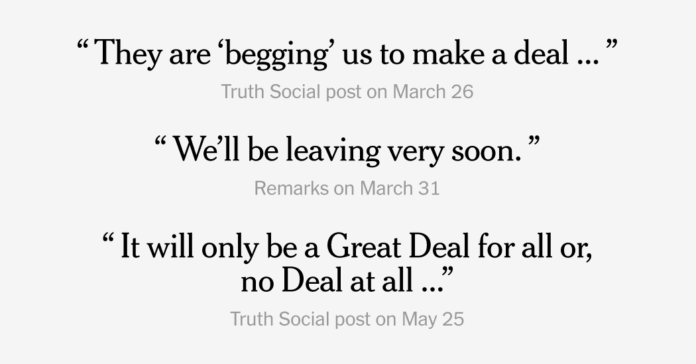
It is a familiar pattern: For weeks now, Mr. Trump has veered between talk of negotiating, bombing and blockading — sometimes all in the same day. He has even suggested more than once that the war is already over.
The New York Times analyzed the president’s statements suggesting that the conflict was drawing to a close and compared them with the reality of the moment.
Often, there was a wide disconnect. Mr. Trump has repeatedly threatened to use extreme force, only to hold his fire. In many cases he has made claims of major diplomatic progress that later proved unfounded, fueling criticism that he is trying to calm markets and relieve political pressure.
One of the first times a comment by Mr. Trump had an outsize effect on the markets was on March 23, when he instructed the Pentagon to postpone any attacks on Iranian power plants and energy infrastructure for five days.
Mr. Trump’s suggestion that the administration was seeking an off-ramp from the conflict rallied investors.
Oil prices fell more than 10 percent on March 23
Note: Data shows future contract prices for Brent crude oil. Source: LSEG Data & Analytics.
For the first time in almost two weeks, Brent crude, the international oil benchmark, closed below $100. The last time the oil market had fallen so dramatically in response to Mr. Trump was on March 9, when he told CBS News that the Iran war was “very complete.”
That same day, Mr. Trump told reporters that diplomatic talks were underway with Tehran, claiming a “real possibility of making a deal.” The speaker of Iran’s parliament denied that, writing on X that “fakenews is used to manipulate the financial and oil markets and escape the quagmire in which the US and Israel are trapped.”
Days after posting that talks were going well, Mr. Trump once again resorted to threats. He posted on Truth Social on March 30 that he would take out Iran’s energy infrastructure if the Strait of Hormuz was not immediately opened.
The stock market hit its lowest point of the year. The next day, Mr. Trump promised that the U.S. would be leaving “very soon,” giving the market a boost.
The S&P 500 had its worst day of the year on March 30
Note: Data is through May 18. Source: LSEG Data & Analytics.
Mr. Trump addressed the nation on April 1. While he did not predict an imminent resolution to the conflict, he said that his military objectives would be completed “very shortly” and that diplomacy was underway.
The stock market continued to tick up in the following days.
As negotiations have dragged on, the president has alternated between claims of diplomatic progress and threats of military escalation, neither of which have materialized.
Mr. Trump began April with some of his most dramatic threats of the war, including one to destroy Iran’s “civilization” on the night of April 7.
But later that evening, Mr. Trump announced one of the biggest developments of the war so far: a two-week cease-fire mediated by Pakistan.
Markets welcomed the cease-fire deal, which was supposed to reopen the Strait of Hormuz, but they did not move as much as they had earlier in April.
Oil prices initially fell, but have proven volatile
Notes: Note: Data shows future contract prices for Brent crude oil. Data is through May 18. Source: LSEG Data & Analytics.
Tehran quickly said that continued fighting in Lebanon between Israel and Iran’s ally, Hezbollah, violated the deal, and Iran kept the strait closed. Mr. Trump argued Iran wasn’t upholding its end of the bargain.
Before the start of the war, about a fifth of the world’s oil and gas traveled through the strait. But once the war began, shipping traffic plummeted.
Shipments of oil through the Strait of Hormuz have slowed to a trickle
Note: The data is an index based on the daily volume of crude oil shipped out of the Strait in metric tons. The index is calculated by dividing the volume by the average volume from January to March 2025 and multiplying by 100. Data is through May 17. Only includes ships with trackers turned on. Source: AXSMarine and the World Trade Organization
Iran has repeatedly promised to open the strait as part of the cease-fire agreement, but this hasn’t happened.
After the first round of negotiations with Iran failed on April 11, Mr. Trump announced a U.S. blockade of Iranian ports to cut off Tehran’s lucrative oil exports.
Furious, Iran said the strait would remain closed so long as the blockade continued.
In late April, Mr. Trump agreed to indefinitely extend a cease-fire and said U.S. officials would return to Pakistan for more talks. Days later, he canceled those talks.
The next week, on April 28, gasoline prices rose to their highest level in four years — a sign that markets have become far less responsive to Mr. Trump’s bullish commentary than they were at the war’s start.
Mr. Trump made several new claims about diplomatic progress in early May. But subsequent events again punctured his optimism. When Iran sent Mr. Trump a May 10 letter that restated its hard-line demands, with no new concessions, Mr. Trump dismissed it as “a piece of garbage.”
The cycle repeated again over Memorial Day weekend, as Mr. Trump declared that the United States was close to a deal to extend the cease-fire and open the Strait of Hormuz. But Mr. Trump also hedged those claims, suggesting that more time might be needed. By Monday, the United Strikes had conducted a round of strikes on southern Iran and Mr. Trump had threatened to resume the “shooting.”
As of Tuesday, the negotiations continued.