


What would it take to stop Black boys from disappearing into drug trafficking networks across northern Ontario? Not more policing, argues prison abolitionist and scholar Ruth Wilson Gilmore, but more safe housing, funded schools and community spaces where youth can gather safely.
That is what a growing body of Black community leaders is arguing in response to a crisis that The Fifth Estate documentary Missing Black Boys brought into national view in January: Black boys as young as 14 are lured into gangs and sent to remote parts of the province to sell drugs.
Youth gang recruitment is not a matter of individual choice or criminality, but one shaped by inequality, institutional neglect and racialized perceptions. And punishment alone cannot solve it.
Indigenous youth from northern reserves, where some communities have declared a state of emergency, are also part of this troubling reality. The same conditions that leave Black boys vulnerable to recruitment into exploitative and violent economies leave Indigenous youth vulnerable too.
Anishinaabe journalist and author Tanya Talaga has described this as an insidious web of drug-related violence in which Indigenous and Black youth are disproportionately impacted.
Black leaders respond
In recent months, community leaders, educators and public workers have come together to ask what makes Black youth vulnerable to recruitment, and what kinds of structural interventions can prevent it?
Black boys are not just going missing. They are being drawn into exploitative economies and transnational and intercity webs of violence. Recruitment often begins on social media, where older youth lure boys with promises of fast money.
Until recently, media outlets did not pay enough attention to these cases, reflecting broader racialized ideas about violence, innocence and vulnerability.
And if the problem is not straightforward, neither is the solution.
Shana McCalla, founder of Find Ontario Missing Black Boys, and Camille Dundas, who in 2025 authored a three-part investigative series, have been instrumental in bringing this issue into public view.
Recently, McCalla submitted a brief to Ontario Solicitor General Michael Kerzner outlining 15 recommendations to address the crisis of Black boys being groomed into drug trafficking networks. Like other Black leaders, she insists that boys recruited into criminal activity should be treated as victims of exploitation and human trafficking, not as criminal offenders.
This means being connected to victim services, trauma-informed care and culturally relevant support. In their advocacy, these leaders have pointed to education, media and lack of opportunities as some areas that need urgent attention.
Classrooms and courtrooms
Anti-Blackness in education is well-documented. The treatment of Black youth as adults when they make mistakes starts in school, often leading to disproportionate suspensions.
But when rethinking the school-to-prison pipeline, Black studies scholar rosalind hampton notes that practices of control found in prisons were established earlier within public education, bringing our attention to the carceral connections between schools and prisons.
Read more: How to curb anti-Black racism in Canadian schools
How is this racialized perception produced? For race scholars, the answer is complex.
My research suggests that visual cultures of everyday institutions, schools, media and digital platforms play a vital role and influence how children and youth are seen and how they come to see themselves.
Masculinity, money and risk
Images shape how we understand the world and our place within it. Cultural theorist Nicholas Mirzoeff, for example, explains that we live in a visual global environment where the connection between images and how we think of race has a long history.
Youth are immersed in visual cultural production circulating across digital platforms, from social media to music videos, influencing how they see themselves and how they want to be seen.
Bizz Loc, a Toronto rapper featured in The Fifth Estate documentary, is currently serving a 7.5-year sentence for his involvement with the Eglinton West Crips street gang. In music videos of his like “I’m Bacc Crodie,” imagery of youth flashing gang signs, mimicking gun gestures and referencing rivalries circulates a version of Black masculinity tied to risk, conflict and money.
Transfeminist philosopher and essayist Sayak Valencia’s concept of gore capitalism helps explain how, in contexts of inequality, violence can be turned into something that attracts attention and generates value.
In Bizz Loc’s case, masculinity is constructed through proximity to risk and money, offering young men a way to be seen and valued when other opportunities are limited. This visual language is part of a broader web that helps sustain violence through its aestheticization.
At the same time, as American sociologist and author Tricia Rose notes, hip-hop doesn’t just describe street life shaped by chronic Black joblessness, it also educates, critiques injustice and pushes for safer, more just communities.
Yet the versions that are most visible today often narrow these stories.
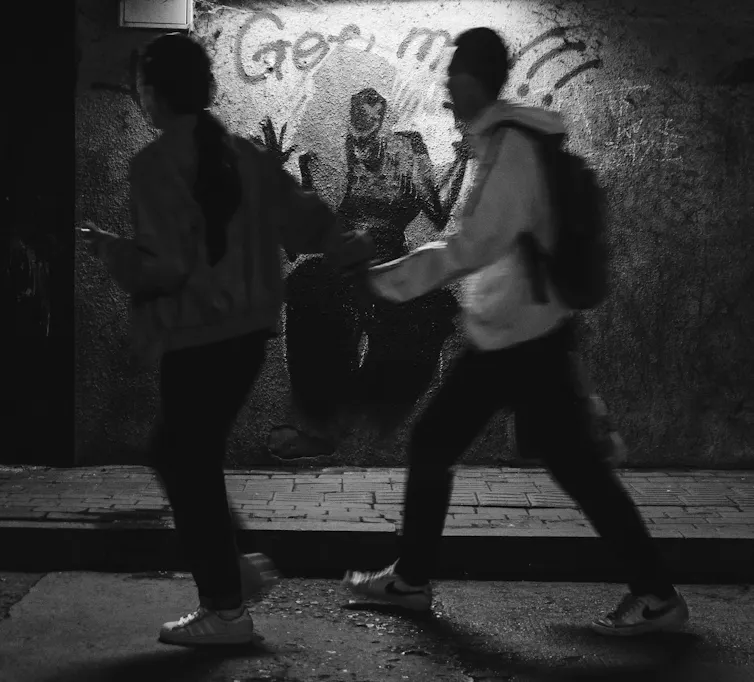
An abolitionist approach
Dundas raises a pressing question: if it costs close to $97,000 a year to keep a youth in custody, how might those resources be better invested in supporting young people?
Precise figures vary and remain difficult to calculate. There isn’t clear and up-to-date data on governments’ spending on the youth justice system.
What is clear, however, is that Black and Indigenous youth are disproportionately represented within it. Whether it’s $57,000 a year or over $1,400 a day, provincial governments spend heavily on incarcerating youth.
Abolition, Ruth Wilson Gilmore explains, is about the presence of the conditions that sustain life like food security, secure employment, parks and access to nature, clean water and clean air.
In the absence of these conditions for Black and Indigenous youth, other systems step in.
Or as Fred Moten and Stefano Harney, Black studies and critical theorists, put it, the target of abolition work is not prisons, but a society that makes prisons necessary. Rather than punishment, the abolitionist question is how do we build communities where fewer young people are vulnerable to recruitment before they encounter violence at all.