

Our goal at The Upshot is to produce distinctive explanatory journalism. But how do we get there? Some of our best work starts with a reporter squinting at a table, or a list, or a rough chart, and trying to divine meaning from it. Does it say something new — about the federal budget, about imports, about a completely unexpected topic?
Here are some memorable examples of when that process paid off this year: when a few numbers, the shape of a line, or the pattern on a map led to more exploration and analysis, and, eventually, to the articles we’ve linked to below.
We hope you enjoy this peek under the hood of what we do — we’ll be back at it again in 2026.
The I.R.S. is auditing taxpayers far less than it used to
I.R.S. data book
As the Trump administration moved to cut the work force of the I.R.S., undoing the Biden administration’s hiring spree, much of the reporting and debate was about directionality: Should there be more or less tax enforcement than there is now? It was hard to find out how the actual audit rate compared with five, 10 or 40 years ago.
If someone was the baseball home run leader for a year, you’d want to know the comparison with previous seasons. Was it historic? Or ordinary? I was curious if the audit rates the Biden administration had been pushing for would have been a significant departure from past administrations, or simply an increase from the first Trump administration. I was also curious if a new drop in audit rates would break records, or just return to a percentage that is typical during Republican administrations.
Going through old I.R.S. databooks, I found that the audit rate today was at a record low going back to at least 1950. This meant that with the additional Trump cuts to the I.R.S. work force, the audit rate is likely to reach new lows. Even with the increases during the Biden administration, the 2023 audit rate was still less than half of what it was during the Obama administration. — Ben Blatt
One lesser-known reason E.V. sales keep rising
You may have heard stories about the challenge of knowing when and how to charge an electric vehicle while out on the road. Several years ago, one friend had to turn the car’s heat off and inch anxiously down the freeway just to make it to the next charger. It seemed reasonable not to want an E.V. under those conditions — and yet, E.V. sales have kept rising. Why?
Even a quick look at federal data for fast chargers (the kind that can refill your car in half an hour) helps explain.
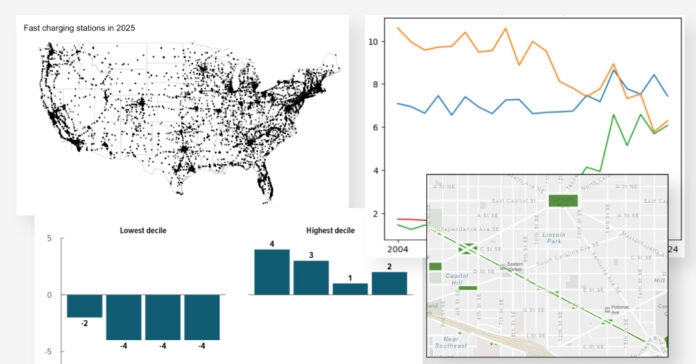
In 2015, the charger network across the country looked empty — in the map above you can see the outlines of some major highways, but it was an imposing landscape for anyone who might need to charge. By 2025 the map is dotted with thousands of stations and tens of thousands of fast chargers. We tried to figure out what that actually meant for drivers trying to cross long distances.
What we found is that, even though there are still issues to work out, it has never been easier to take an electric vehicle road trip. — Francesca Paris and Eve Washington
The big policy bill helps the rich and hurts the poor unlike any other
Congressional Budget Office
As Congress revised and debated its major tax and domestic policy bill this summer, we were perpetually reloading the Congressional Budget Office’s website, where the nonpartisan agency was sharing its detailed analyses of what the legislation would mean for the budget. And, to our surprise, the nonpartisan group published a kind of analysis it had never done before.
To answer questions about the overall impact of the legislation, it looked at its effects for different income groups. This kind of breakdown, called a distributional analysis, showed that the bill didn’t just cut taxes more for higher earners than poorer Americans, but that when those tax cuts combined with changes to the social safety net, it also left poor Americans significantly worse off.
This chart, later revised after the bill passed, got us wondering whether there was any congressional precedent for legislation that helped the rich and hurt the poor this much. We weren’t able to find any such past example. — Emily Badger, Alicia Parlapiano and Margot Sanger-Katz
The surprising spaces in D.C. already under federal control
Open Data D.C.
President Trump and congressional Republicans have tried to assert more control this year over Washington, an overwhelmingly Democratic city where they say officials have failed to halt crime and clean up public spaces. But the effort, and the politics around it, collide with this awkward reality: The federal government already controls much of the city. The National Park Service manages parks that have run-down facilities. The federal government controls many aspects of the local criminal justice system. The president has complained that the city’s grass looks shabby — but in many places, that’s on the feds, too.
This is generally familiar to anyone who lives in the District. But exactly where and how much land is under federal control is not well known. So we tried to assemble a map of all the land in the city controlled by federal agencies and the military (the District’s open data portal, seen in the screen grab above, makes this possible). Some surprising and telling details emerged: The Park Service owns even the little strips of grassy road median running down the middle of Pennsylvania Avenue Southeast. Move over, Yosemite! — Emily Badger and Amy Fan
It’s possible to precisely measure the amount of gore in a movie
In June, we set out to measure how Steven Spielberg’s “Jaws” continues to shape movies five decades later. One part of that analysis used a machine learning data set released by Netflix, containing more than 150,000 labels on short video clips, as tagged by human video editors. We then took that data and trained a classification model to score how much gore a short clip contains — which then allowed us to measure the “goriness” of a movie overall.
“Jaws” is already famous for being more suspenseful than gory (Mr. Spielberg creatively hid some bloody moments with splashing water and the cover of night), but now we could make a rigorous comparison with other films. In the “Jaws” emulator “Piranha,” for example, almost every on-screen death is accompanied by visible blood. That difference is reflected in the charts above, where “Piranha” has a more sustained gore score over the course of the film. — Eve Washington and Rumsey Taylor
Many state governments are paying a single company high rates for income data
2024-2028 contract between Equifax and Kansas.
In an interview about how North Carolina plans to implement the new Medicaid work requirement, the state’s Medicaid director casually mentioned a small part of the process that he expected would cost his state more than $10 million a year. That got our attention.
The line item came from the company Equifax, which has a big business helping states verify the incomes of people who apply for social welfare programs. The Republican tax and domestic policy bill requires deeper and more frequent checks for Medicaid and nutrition assistance — meaning that business could grow a lot. We started searching for state contracts in databases and making public records requests to find out just how expensive this service really was.
The rate per query that Kansas pays, for example, is set to reach a staggering $19.39 in 2028, up from $6.79 in 2024. And other state contracts showed similar patterns. With very little competition, the company had been able to negotiate large price increases with states for this vital service. Government programmers and entrepreneurs are racing to develop alternatives in time for the 2027 launch of Medicaid’s work requirement, but Equifax still sees the law as “a big positive.” — Asmaa Elkeurti, Sarah Kliff and Margot Sanger-Katz
Boys haven’t changed; kindergarten has
From “Is Kindergarten the New First Grade?” by Daphna Bassok, Scott Latham, and Anna Rorem
In reporting a series of articles on boys and young men this year, I kept hearing that boys were having a harder time in school than they used to. I knew that boys started kindergarten behind girls — largely because they mature later — but I couldn’t figure out why boys might be struggling more than they had before.
Then I found a table that explained it. It wasn’t that boys changed, but that kindergarten had. Researchers compared what kindergarten was like in 1998 and 2010. In just over a decade, kindergarten had become completely different — more worksheets and phonics drills, fewer art areas and costume corners. The change was driven by No Child Left Behind, the 2002 law that increased pressure on teachers to prepare their students for standardized tests.
Teachers became much more likely to believe that children should start formal math and reading education before kindergarten, and to learn to read by the end of it. It upended the standard practice of letting young children learn through play, and led many kindergartners — especially boys, who generally develop the skills to sit still and focus later — to struggle. — Claire Cain Miller
But video games are changing the lives of young men
We’ve heard a lot about how much time girls spend on social media, and how it’s affecting them. But we wondered how boys and young men are spending time online. So we looked at the American Time Use Survey, and noticed a sharp increase in time gaming among boys, especially alone.
After more slicing of the data, we discovered that time spent gaming had increased at the expense of activities like playing sports, socializing with friends or family, and particularly watching television with others. Was this increase in gaming contributing to a rise in loneliness? Or was the greater time spent online just a change in the nature of socializing?
Interviews with people who parent, study or work with young people helped shed light on this shift. In many ways, video games are benefiting boys and young men, especially as a social outlet. But as gaming has become more addictive and constantly accessible on phones, our reporting found, the increased time spent playing is also contributing to inattentiveness in school, the decline in young men’s work hours and their overall feeling of being adrift. — Claire Cain Miller and Amy Fan
Some Trump voters are returning to the Democratic Party
One of the toughest questions in election analysis is whether candidates won because they turned out more of their supporters, or because they won swing voters or even won voters from the other side. The tabulated results rarely provide decisive answers: If one party’s candidate wins more voters than before, that doesn’t clarify where those additional voters came from. But in November’s New Jersey governor’s election, the data was clear enough that it was possible to demonstrate that the Democrat, Mikie Sherrill, must have flipped voters who had backed President Trump in 2024.
In heavily Hispanic Union City, Ms. Sherrill won by more votes than Kamala Harris did one year earlier. In a low-turnout off-year election, it’s hard to imagine that could have happened simply due to turnout, even though it’s hard to prove. Fortunately, we could prove it. My colleagues obtained vote history data from New Jersey, revealing exactly who voted in the election and who did not. The eureka moment: the screenshot above, revealing that fewer Democrats voted in Union City than in 2024, even though Ms. Sherrill won over 2,000 more votes than Ms. Harris. For that to be true, some of those Democrats must have voted for Mr. Trump in 2024 and returned to the Democratic fold in 2025. — Nate Cohn
What’s really slowing down the bus in New York
One of Zohran Mamdani’s central pledges was to make buses “fast and free.” But what would really need to go into making buses faster? We worked with the transportation planner Annie Weinstock of People Oriented Cities to take stock of the range of options available to the incoming New York mayor to make good on that promise. But we needed extremely granular bus data — individual passenger counts and boarding times — to do it.
So we rode the B41 bus up and down Flatbush Avenue in Brooklyn, counting how many people got on and off at each stop, how many paid and how many didn’t, how long it took to board and alight, and how long each traffic light cycle was.
Ms. Weinstock used our data to calculate how the B41 spends its time on Flatbush. One big takeaway? The bus spends most of its time sitting at red lights. Mr. Mamdani’s plan — to eliminate fares and let people enter at all doors — may speed up boarding, but he’ll need to do a bit more to help with the red lights. — Emily Badger, Larry Buchanan and Stefanos Chen
One of the first things DOGE did was mistake ‘millions’ for ‘billions’
Elon Musk’s Department of Government Efficiency roared into Washington early this year, canceling thousands of government contracts and grants in its doomed quest to eliminate $1 trillion in federal spending by the end of the year. A few weeks into the effort, DOGE posted a government website titled the “Wall of Receipts” that promised to be a transparent record of canceled programs and dollars saved. We were immediately interested.
But it took only an examination of the first — and largest — item on the list to find a problem. DOGE claimed it had saved the government $8 billion by canceling an I.T. contract at Immigrations and Custom Enforcement, an agency with a $9 billion annual budget. We looked closely and saw the listing was a mistake: The contract was worth only $8 million. The discovery of that error launched an extensive line of reporting on the careless way DOGE was carrying out its work, and the many ways it misunderstood the government it aspired to reshape. — Margot Sanger-Katz, Aatish Bhatia, Josh Katz and Ethan Singer